Aftermarket Sales Software for Manufacturers —
The Complete Guide
From install base opportunity identification to signed contracts, parts quotes, rebuild programs and field service quoting — this is the full picture of what aftermarket sales software covers, how the commercial pipeline works, and why generic CPQ and ERP miss the most valuable part.
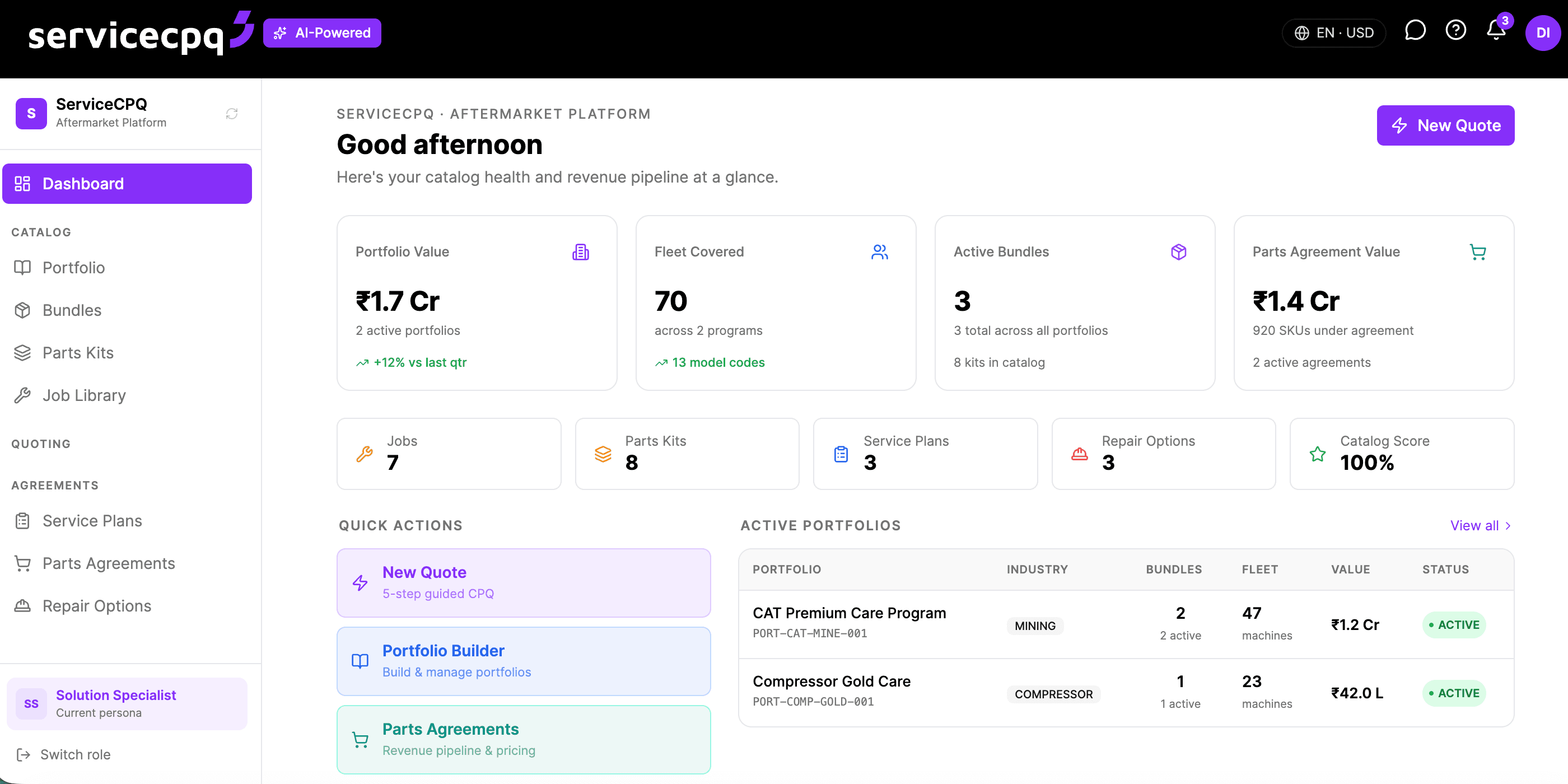
Aftermarket sales software for manufacturers covers the full commercial process of selling service revenue after equipment is sold — from identifying opportunities in the install base, through structured pursuit and gap analysis, to configuring, pricing and quoting service contracts, PM packages, parts agreements, rebuild programs, extended warranty and repair options. It sits between ERP (transactions) and field service (dispatch) — handling the commercial selling layer neither platform was built for.
What Aftermarket Sales Software Actually Covers
Most manufacturers have SAP or Oracle running their ERP. Many have a field service platform scheduling technicians. Some have Salesforce tracking customer contacts. What almost none of them have is the commercial layer in between — the software that finds aftermarket revenue opportunities, structures the right service package for each customer, prices it correctly, and generates a quote that gets signed.
That gap between ERP and field service is where the majority of aftermarket revenue is either won or silently lost. Aftermarket sales software fills it.
"The gap between ERP and field service is where the majority of aftermarket revenue is won — or silently lost."
Manages Transactions
Work orders, billing, inventory, warranty claims. Does not identify opportunities, structure packages or generate quotes.
Manages Dispatch
Technician scheduling, job management, parts consumption. Does not sell contracts, price service packages or quote customers.
Manages Contacts
Customer relationships, activity tracking, pipeline visibility. Does not configure service packages, calculate lifecycle costs or enforce pricing rules.
Manages the Commercial Gap
Identifies opportunities, structures packages, prices correctly and quotes every aftermarket product — from first alert to signed contract.
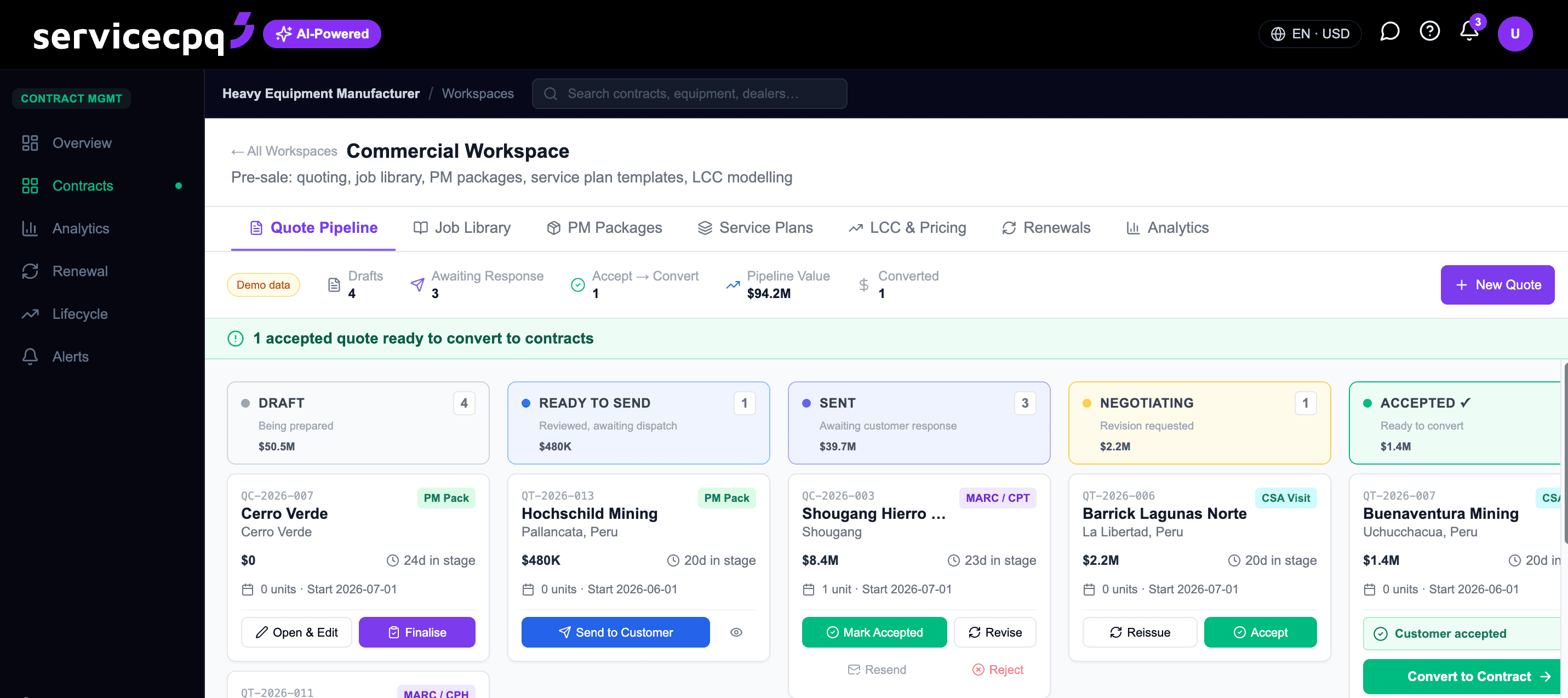
From Service Opportunity to Quote and Order
The aftermarket commercial pipeline has four distinct stages. Most manufacturers have tools for stage one (CRM) and stage four (ERP). The revenue is lost in stages two and three.
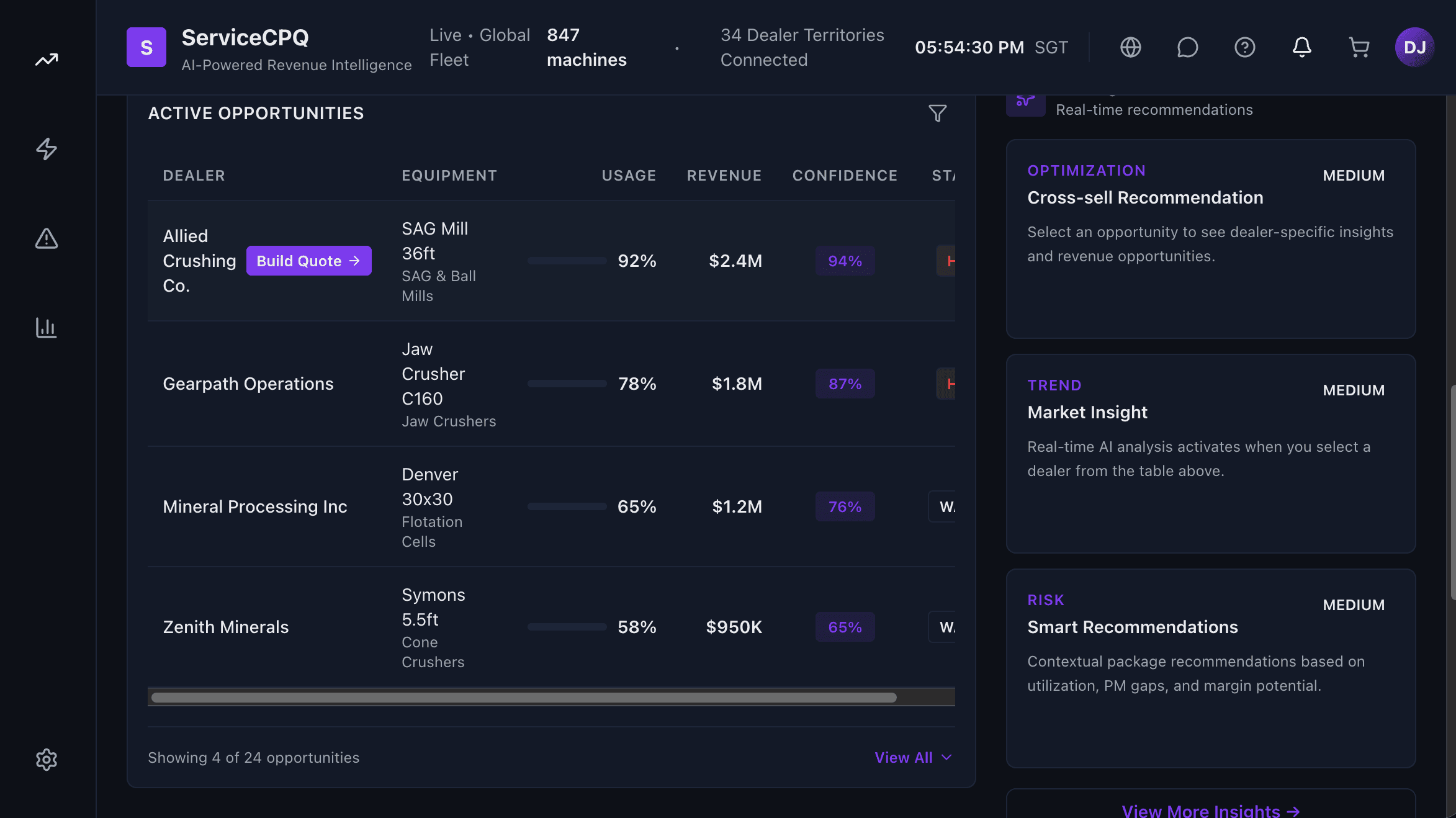
Propensity Scoring — Finding the Right Accounts to Pursue
Not every uncontracted asset is equal. A machine at 70% of its design life, operating in high-utilisation conditions, with a history of unplanned breakdowns has a fundamentally different service revenue propensity than a lightly used machine in year one of its lifecycle.
ServiceCPQ's propensity engine scores every asset in the install base using operating hours, age, failure history, operating environment, and current coverage status — ranking accounts by revenue likelihood so sales teams pursue the highest-value opportunities first rather than working alphabetically through a list.
Gap Finding — Mapping Coverage vs Exposure
Gap analysis maps what each customer currently has against what they should have given their fleet, operating conditions, and risk profile. Assets with no PM plan, machines with expired warranty and no service contract, fleets with partial coverage — all surfaced automatically with a gap score and recommended package.
See the Full Aftermarket Pipeline — Live Demo
ServiceCPQ walks you through opportunity identification to signed contract in a single platform. Book a walkthrough tailored to your equipment type.
Watch DemoEvery Aftermarket Product Type — Configured, Priced and Quoted
Aftermarket service CPQ must handle a fundamentally different product set to equipment CPQ. Each product type has its own pricing logic, coverage rules, approval thresholds and contract terms.
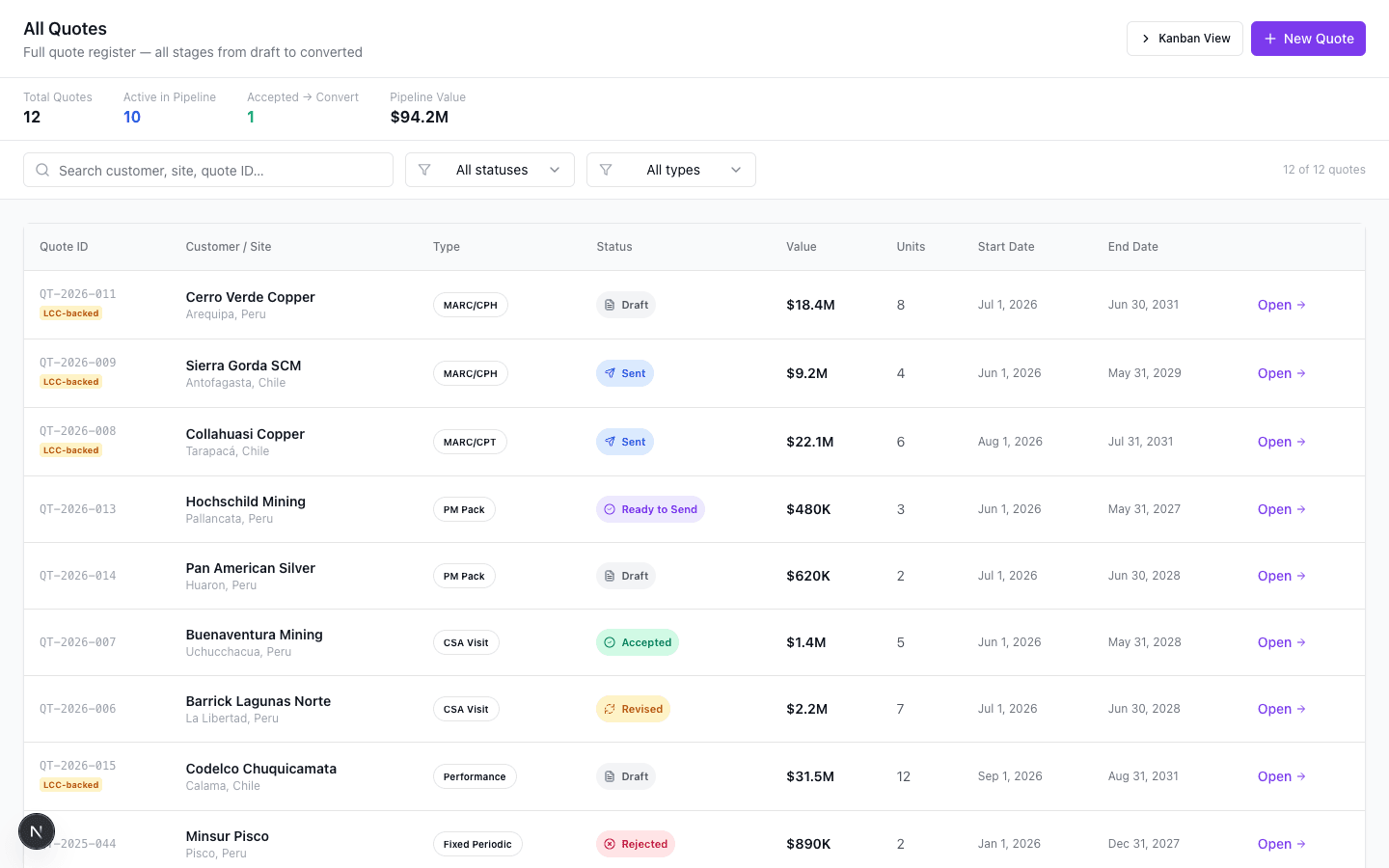
MARC, Full-Maintenance, T&M and Hybrid Contracts
Maintenance and Repair Contracts (MARC) are the highest-value aftermarket product for capital equipment OEMs. ServiceCPQ's contract builder covers nine configuration steps — scope, asset list, CPH rate modelling, SLA terms, parts and labour inclusions, exclusions, escalation triggers, and renewal conditions.
- CPH (Cost Per Hour) rate modelling linked to site operating parameters
- Risk-adjusted pricing by asset age, utilisation and failure history
- Coverage tiers: gold, silver, bronze with automated pricing
- Multi-asset contract builder — fleet pricing and bulk discounting
Preventive Maintenance Packages — Interval, Usage or Calendar
PM packages are the most frequently sold aftermarket product and the most commonly under-priced. ServiceCPQ builds PM packages from a job library — pre-defined task sequences, parts lists and labour times per interval — then prices them with margin guardrails and dealer-specific discounting rules.
- Interval-based, operating hour or calendar-triggered PM
- Job library with task sequences, parts and standard labour times
- Bundled PM packages sold at equipment handover
- Multi-year PM packages with escalation clauses
Extended Warranty — Risk-Rated and Dealer-Ready
Extended warranty programs lose money when priced on gut feel and gain the most margin when risk-rated properly. ServiceCPQ prices extended warranty by asset age, operating hours, failure history and operating environment — with coverage terms linked directly to the asset object in the system.
- Risk-rated pricing model by asset condition and age
- Coverage period, exclusions and claim limits configurable per product
- Dealer self-service quoting with OEM price floors enforced
- Warranty event auto-linked to contract renewal trigger
Parts and Kits Management with Quoting
Parts quoting is the highest-frequency aftermarket transaction — and the one most commonly lost to third-party parts suppliers when the OEM is too slow, too expensive or too difficult to buy from. ServiceCPQ's parts and kits CPQ closes that gap.
Natural Language Part Search
Dealers and service reps describe what they need in plain language — "hydraulic pump for 740C underground loader" — and AI matches to the correct OEM part number, including supersessions and substitutions.
Kit and Assembly Quoting
Pre-configured kits — service kits, overhaul kits, seasonal PM kits — quoted as single line items with constituent parts exploded automatically. Bundle pricing with margin protection built in.
Supersession & Substitution
Discontinued parts automatically resolved to current equivalents. Substitute parts surfaced with compatibility confirmation — no more "no longer available" dead ends that push customers to third-party suppliers.
Annual Parts Agreements
Multi-year parts supply agreements priced with AI-suggested quantities based on asset failure history and operating hours. Tiered pricing by dealer tier, volume commitment and payment terms.
Parts agreements deserve special attention because they convert a transactional relationship into a commercial one — the customer commits to buying from you for twelve or twenty-four months, at an agreed price, eliminating the quote-by-quote friction that competitors exploit. ServiceCPQ builds parts agreements from historical consumption data, recommends coverage quantities and prices the package automatically.
Rebuild IQ — Component Rebuild Quoting for Large Workshops
Component rebuild programs are among the highest-margin aftermarket products — and among the hardest to quote accurately. A hydraulic pump rebuild, an engine rebuild, a gearbox overhaul — each requires a scope assessment, a parts list, a labour estimate, and a decision on whether rebuilding is cheaper than replacing with a new or remanufactured unit.
Most workshops quote rebuilds from memory or from an outdated price list. ServiceCPQ's Rebuild IQ module structures the whole process.
Asset History-Driven Rebuild Scoping
Rebuild scope is generated from the asset's service history — previous failures, operating hours, component replacement history — not from a generic template. The system recommends which components to include in the rebuild scope and prices them from the workshop job library.
- Asset history imports from ERP or field service platform
- Component-level rebuild scope recommendation
- Rebuild vs replace decision modelling — cost comparison at quote stage
- Labour estimate from workshop job library and standard times
- Phase-gated approval for high-value rebuild quotes
- Lifecycle cost projection post-rebuild
Job Library — Standard Times and Task Sequences
A centralised job library stores pre-defined task sequences, standard times, required parts and skill requirements for every common service job. Workshop service quotes are built from the library — consistent, fast and margin-protected — rather than quoted from scratch each time.
- Task sequences with parts and standard labour times
- Machine-specific variations managed per model
- Library-driven quotes consistent across all service locations
- Real-time job cost vs quoted price monitoring
See Rebuild IQ and Parts CPQ in Action
Watch how ServiceCPQ generates a rebuild quote from asset history — and a parts kit quote from a natural language description — in under 5 minutes.
Book DemoField Service Quoting — Integrated with Your FSM and Work Orders
Field service quoting happens at the worst possible moment for accuracy — a technician is standing next to a broken machine, the customer wants to know what it will cost, and the only tool available is a phone call to the service desk.
ServiceCPQ integrates with field service management platforms to give technicians and service advisors a quote-at-point-of-service capability — connected to the work order, the asset history, the parts catalogue and the pricing rules.
Quote at Point of Service
Technician opens work order on mobile — ServiceCPQ pre-populates repair scope from fault codes, surfaces matched parts and generates a customer quote without leaving the site.
Work Order to Quote — Automatic
Work order fault codes, asset details and parts consumption feed directly into CPQ. No re-entry. Quote reflects actual scope, not a remembered approximation.
Automatic Coverage Determination
Every repair quote checks MARC and warranty coverage first — automatically. In-contract work routes to contract fulfilment. Out-of-contract triggers a commercial quote for the customer's approval.
Workshop and Field — Same Platform
Workshop service advisors and field technicians use the same quoting engine — same parts catalogue, same pricing rules, same approval workflows. Consistent pricing regardless of where the service happens.
Supported Field Service Integrations
- SAP Field Service Management (SAP FSM)
- Microsoft Dynamics 365 Field Service
- Salesforce Field Service
- IFS Field Service Management
- ServiceMax
- Custom REST API for bespoke FSM platforms
From Digital Alert to Complete Quote — In One Click
Your telematics platform is generating fault codes and operating data every hour. Most of it sits in a monitoring dashboard and turns into a work order when a machine stops. Very little of it turns into a commercial conversation before the machine stops.
ServiceCPQ's alert monetisation engine changes that — converting digital alerts into structured commercial quotes before a machine breaks down.
The quote generated from an alert isn't limited to the immediate repair. ServiceCPQ uses the alert as a commercial trigger — surfacing related opportunities at the same time: an upcoming PM package, an expiring extended warranty, a MARC renewal within 60 days. One alert, one interaction, multiple revenue events addressed.
Dealer Quoting Services — Self-Service with OEM Control
Dealer quoting software is the most operationally impactful aftermarket investment most OEMs can make. Every quote that used to require a call to the OEM service desk can instead be generated by the dealer in minutes — at OEM-correct pricing, within OEM-approved scope, with the margin floor enforced automatically.
What Dealers Can Quote — Without Calling the OEM
ServiceCPQ's dealer portal gives authorised dealers a structured self-service environment to quote every aftermarket product type — with OEM rules enforced in the background.
- Service contracts — MARC, PM and extended warranty
- Parts and kits — NLP search, supersession, kit pricing
- Repair options — in/out of contract determination automatic
- PM packages — from job library with bundled pricing
- Rebuild programs — scope from asset history
- Expert handoff request — for complex configurations needing OEM input
OEM pricing rules, margin floors, discount limits and approval thresholds are all enforced by the platform — so dealers quote fast and the OEM retains commercial control without being in every transaction. Quotes that exceed discount limits or involve unusual configurations route automatically to OEM review — everything else clears without intervention.
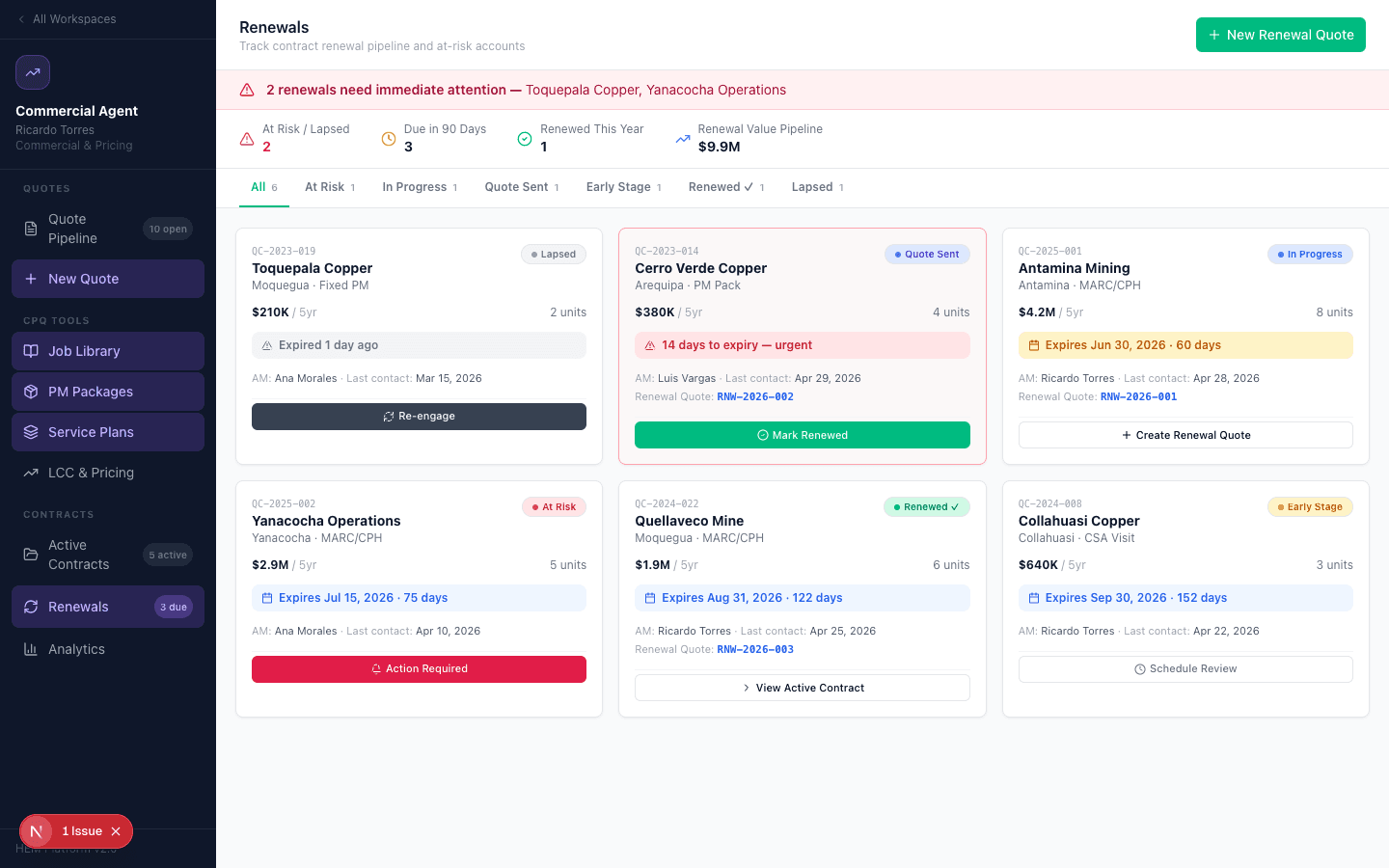
Contract Lifecycle Management — From Signed Quote to Renewal
A contract sold is not revenue secured until it's renewed. The contract lifecycle — activation, performance tracking, renewal preparation, CPH reconciliation — is where most OEMs lose 15–30% of the contract value they think they've sold.
Live CPH vs Budget
Actual cost-per-hour tracked against contract CPH budget in real time. Budget overruns flagged before they become customer disputes. Margin monitored at contract level throughout the term.
Automated Renewal Triggers
Renewal workflows trigger automatically at 90, 60 and 30 days before contract expiry — with a pre-populated renewal quote built from the current contract terms and updated asset data.
Contract Performance Dashboard
Every active contract has a performance dashboard — service events, parts consumption, uptime commitment vs actual, and financial margin. Visible to OEM service managers and optionally to customers.
Contract Upsell Identification
Contracts with high service event frequency, parts overruns or scope gaps automatically flagged as upsell opportunities — coverage upgrade, scope extension or premium tier migration.
ServiceCPQ vs Tacton vs SAP — Aftermarket Sales Software Comparison
Tacton CPQ is a strong product CPQ platform for manufacturers — it handles configure-to-order and engineer-to-order well. But its service sales solution is a recent addition focused on attaching service packages to new equipment quotes. It does not cover the operational depth of aftermarket service management — rebuild programs, alert monetisation, CPH tracking, dealer quoting — that ServiceCPQ was built for from the ground up.
| Capability | ServiceCPQ | Tacton CPQ |
|---|---|---|
| Service opportunity identification from install base | ✓ | — |
| Propensity scoring and gap analysis | ✓ | — |
| MARC / full-maintenance contract CPQ with CPH | ✓ | Basic service attach only |
| PM package builder with job library | ✓ | Partial |
| Parts and kits CPQ with NLP search | ✓ | — |
| Rebuild IQ — asset history-driven scope | ✓ | — |
| Field service quoting — FSM integration | ✓ | — |
| Telematics alert → commercial quote | ✓ | — |
| Dealer self-service quoting portal | ✓ | Partial — product CPQ only |
| Contract lifecycle — CPH tracking, renewal, upsell | ✓ | — |
| Warranty claim automation | ✓ | — |
| Product CPQ — configure-to-order | ✓ | ✓ — core strength |
| ERP integration (SAP, Oracle) | ✓ | ✓ |
| Purpose-built for capital equipment OEMs | ✓ | Broad manufacturing focus |
Tacton is the right choice for manufacturers whose primary CPQ need is new equipment configuration and quoting. ServiceCPQ is the right choice when the priority is aftermarket revenue — contracts, service, parts, rebuild and dealer quoting — with product CPQ capability included for organisations that need both.