Stop guessing what parts you'll need, and what to charge for them.
Service parts management for machinery manufacturers: demand forecasting, allocation, dynamic pricing and config-accurate quoting on one model of your installed base — not a spreadsheet and a static price list.
Where service parts management goes wrong.
Reactive ordering
Parts get ordered after a dealer calls, not before — stockouts and rush freight eat the margin on every job.
Static price lists
One list price for every customer and region means margin walks out the door on every large account.
Part-number guesswork
Without config-accurate lookup, the wrong part gets quoted, ordered and returned — three times the cost of doing it right once.
The service parts management engine.
Six capabilities on one model — from the demand signal to the fulfilled, correctly-priced quote.
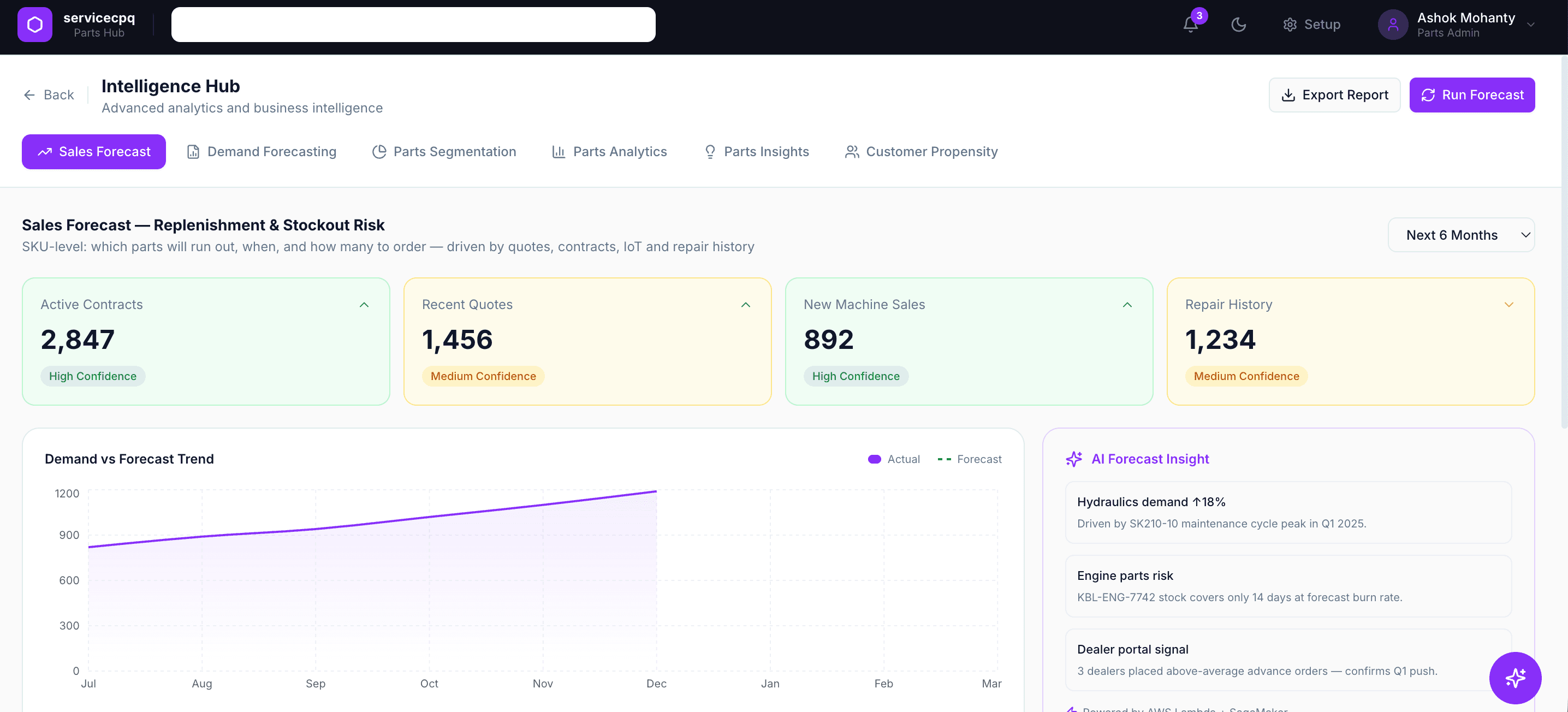
AI predicts part demand from active contracts, recent quotes, new machine sales and repair history — not consumption history alone — with a confidence level on every prediction.
Requests from engineer jobs, dealer orders and van stock are allocated against live stock automatically; returns reconcile against the original order.
Margin and discount guidance — average, minimum, maximum and recommended — applied per part, so reps never negotiate blind.
OEM list price, distributor cost, dealer cost and end-customer price managed as one hierarchy, enforced automatically.
One master record per part — substitutes, alternates, where-used and live stock position — instead of hunting across separate systems for the data that decides a quote.
Live stock, lead times, supersessions and material movements synced from your ERP, so a quote never promises what isn't there.
Describe the repair. Get a costed parts and labour BOM in seconds.
“500hr PM for the HX310” or “hydraulic system rebuild” is enough to start — no form to fill in first.
The agent analyses historical repair work orders for that machine and fault pattern, not a static parts list.
Every generated BOM shows a confidence score and how many work orders it was derived from, so reps know when to double-check it.
Accepted BOMs save as reusable kits for the next identical job.
Every returned part gets a case, not a shelf to sit on.
Every defective part return opens a case, tracked from receipt through final disposition — not a box on a shelf with no record.
Root-cause failure codes are captured and analysed across returns, surfacing patterns before they become a trend.
Each returned part is dispositioned deliberately — scrap, salvage, or remanufacture — instead of defaulting to scrap by habit.
Previously uncatalogued parts or failure modes can be added to master data directly from a case, instead of a separate data-entry backlog.
Frequently asked questions
It's built from multiple live signals — active service contracts, recent quotes, new machine sales, and repair history — rather than historical consumption alone, and each prediction carries a confidence level so planners know how much to trust it.
An AI agent that generates a costed parts-and-labour bill of materials from a plain-language description of the job, drawing on historical work orders and a standard job library — instead of a rep building a BOM line by line from memory.
Each part carries margin-aware pricing guidance — average, minimum, maximum and recommended discount — so reps and dealers quote within guardrails instead of negotiating blind, and pricing is flagged for review automatically as cost or market conditions shift.
It's tracked as a case from receipt through disposition — scrap, salvage, or remanufacture — with failure codes captured for root-cause analysis, instead of returned parts piling up with no record of why they failed.
No — it syncs live stock, lead times, supersessions and material movements from your ERP, and only posts material transactions back, so your ERP of record stays the single source of truth for inventory without carrying all of this workflow itself.