Warranty claims management, anchored to the work order that proves the repair.
Dealer claims to one OEM. A dealer group claiming from six vendors at once. A manufacturer receiving claims in from 1,480 independent service agents. And the OEM side adjudicating all of it. Four directions, one knowledge graph — where coverage, evidence, fraud signals and supplier recovery are derived rather than typed.
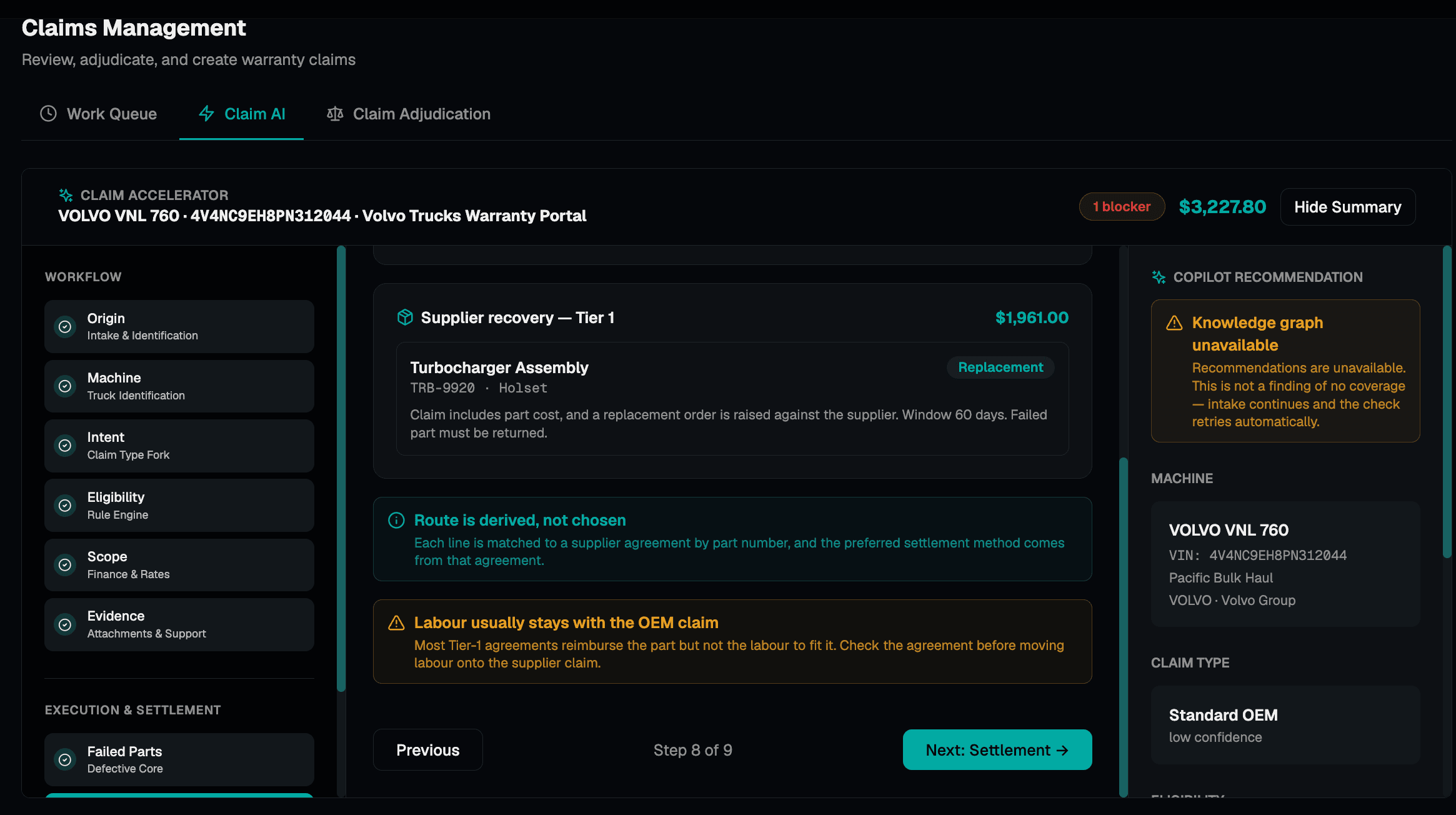
claim adjudication cockpit
What is warranty claims management?
Warranty claims management is the process of capturing, validating, adjudicating and settling warranty claims between the parties who share the cost of a failure — dealer, OEM, component supplier and independent service partner. It covers coverage verification, evidence and labour validation, approval or denial with a recorded reason, settlement against the warranty provision, and recovery of recoverable cost from the responsible supplier.
Almost every claims system in this industry stores a claim as a record with fields on it. The repair that caused the claim lives somewhere else — in a service order, a workshop system, a technician’s notes — and the two are joined by a reference number and an assumption.
That gap is where the money goes. A segment of work claimed twice looks fine on two separate records. A claim with no evidence the work happened looks identical to one with a signed confirmation behind it. Whether the asset was inside its coverage window on the failure date is a question somebody answers from a spreadsheet of contract end dates.
ServiceCPQ closes the gap by storing the repair and hanging the claim off it. Coverage checks, fraud signals and settlement decisions stop being reports someone remembers to run, and become properties of the graph that can be read at submission time.
Who is claiming, and from whom.
These look like four different products in most vendors’ catalogues. They are the same mechanics pointed in different directions — which is why one graph carries all of them, and why a decision made on a truck-OEM claim sits on the same board as one made on a component-supplier claim.
Dealer to OEM
The classic path: a dealer repairs a machine under warranty and claims the cost back from the manufacturer. Branded and non-branded lines run the same flow — the branch point is whether the claim goes to the factory at all, or gets absorbed internally.
Is this machine or this component still in warranty? Every registered coverage is evaluated against the serial and the meter reading, and returns a verdict rather than a date to interpret.
The repair runs as a work order with segments, and each segment carries its own service confirmation. That confirmation is what later proves the work actually happened.
Cause of failure determined, then the charge split three ways — customer, factory, dealer. Where the cause is unknown the claim routes to technical support before any split is made.
Service reports, delivery notes, purchase orders, technical assessments. The claim does not leave the building until the evidence that vendor requires is attached to it.
Registered with the manufacturer and tracked through an eleven-state lifecycle. Accepted claims invoice the factory and reconcile against the provision; rejected ones are re-claimed or absorbed, and the provision moves either way.
Modelled from a dealer's own end-to-end warranty process map, across seven departments: sales, logistics, warranty, workshops, technical support, accounting and field service.
The claim hangs off the repair, not off a form.
The graph holds the repair — work orders, segments, service confirmations, parts, labour, coverage, provisions — and a claim attaches to a segment of it. That one structural choice is where every check below comes from.
A segment can be claimed once, so a duplicate is a property rather than an audit finding. A claimed segment with no confirmation has no evidence behind it, and the graph can say so in those words. Coverage hangs off the asset and the component, so “was this covered” is a traversal.
And because the model subclasses rather than forks — a truck is a machine, a repair order is a work order, a supplier recovery claim is a warranty claim — the same reasoning runs across every vertical without a query being rewritten.
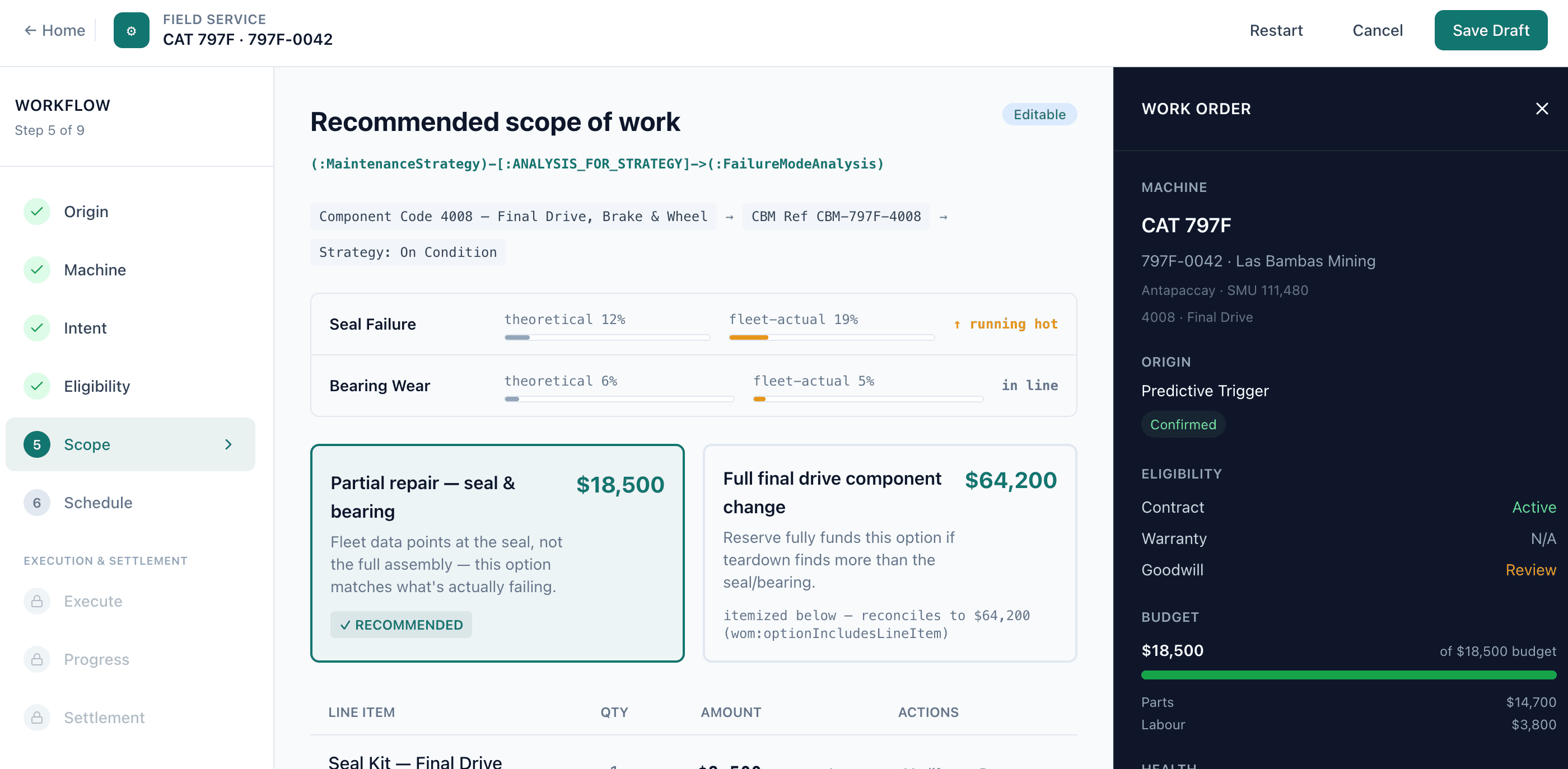
A verdict, not a date to interpret.
Every coverage registered against the asset is evaluated on the failure date and the meter reading, and each one returns one of five answers — with the expiry date and the remaining hours or kilometres attached, so a near miss is visible as a near miss.
In force on the failure date and under every usage limit that applies.
The coverage window closed before the failure date.
The machine passed the hour limit — meter reading, not calendar.
The same verdict for assets metered in distance rather than runtime.
Registered, then withdrawn — which is not the same thing as expired.
Six rules, each one naming what it found.
Not a risk score. Every signal carries a severity and the ids of the graph nodes that produced it, so an adjudicator can open the finding, check it, and disagree with a specific one.
A segment of work is claimed in two live claims at once. Once-claimed exclusivity is a property of the graph, so the duplicate surfaces at submission rather than in an audit eighteen months later.
A claimed segment with no service confirmation recorded against it. There is no evidence in the graph that the work was performed — which is a different and more serious finding than a missing document.
A claim on an asset with no coverage in force — expired, exhausted or never registered — that is not marked as goodwill. Goodwill is legitimate; goodwill that nobody declared is not.
The customer-borne share of a goodwill claim should track hours at failure against expected component life. Where the recorded split deviates from what that formula implies by more than the tolerance, it is flagged with both numbers shown.
More claims on the same asset inside a rolling window than the threshold allows. Sometimes a genuinely bad machine, sometimes not — either way a human should look before it settles.
A claim resubmitted to the vendor more times than the policy expects. Low severity on its own, and useful mostly as a pattern across a dealer or a region.
Auto-approve, manual review, or not applicable — with reasons.
The limits are policy you set, not a model's opinion. What the system contributes is consistency: the same claim gets the same decision on a Friday afternoon as it would on a Tuesday morning, and the reason is written down either way.
Three ways a supplier makes it right.
Recovery does not always mean money. Each supplier agreement declares its preferred branch, and the system proposes the one that supplier actually accepts rather than the one that is easiest to raise.
Reimbursement
The supplier pays. A per-category breakdown of parts, labour and miscellaneous cost claimed against cost settled, with a settlement rate and the note number recorded.
Exchange
The supplier sends the part instead of the money. A replacement order refills the shelf, and the failed core goes back under a return request tied to the same claim.
Replenishment
The supplier pushes stock in kind. A notification goes out with the claim details and the claim carries no part cost at all — labour and miscellaneous only, where the agreement allows them.
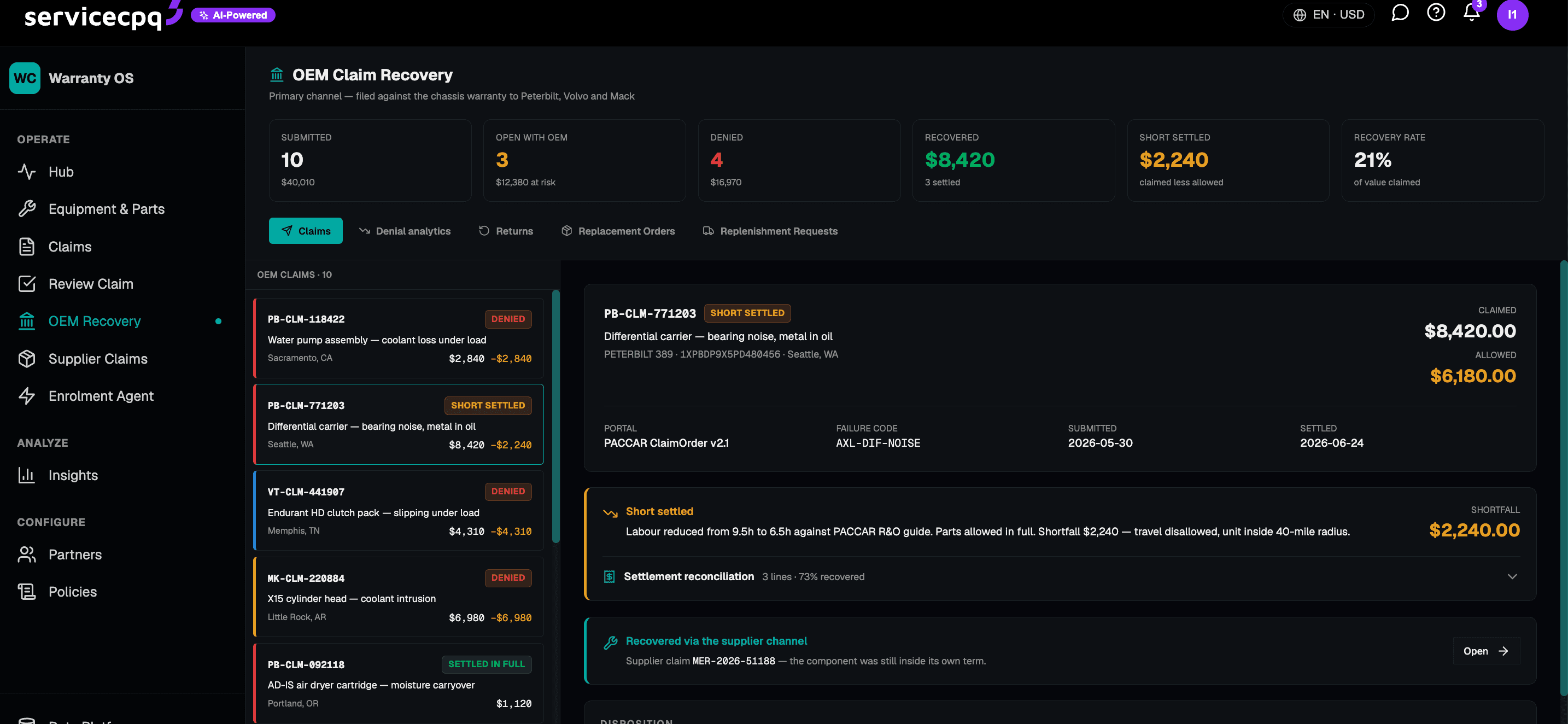
A lens over the claims you submitted, not a second status.
A dealer submitting to many vendors is not a payer. What it needs is consolidated tracking of the vendors’ decisions — pending, approved, rejected, contested — across OEM and supplier claims alike, on one board.
So adjudication is a view over the claim register rather than a parallel lifecycle running beside it. A truck-OEM decision and a component-supplier decision belong on the same screen, because the person chasing them is the same person.
Each decision is its own recorded event — who decided, the outcome, the date, the reason, the amount — and an appeal supersedes the previous decision instead of overwriting it. An internal goodwill approval by a dealer manager is distinguishable from a vendor’s decision, which matters the moment a claim is contested.
What digitising a manual claims operation actually involves.
Figures from ServiceCPQ reference implementations built on real customer claim forms, dealer workbooks and process maps. Commercial terms and prices are the customers' own and are not reproduced here.
Why a claims inbox cannot do this.
Warranty claims management: frequently asked questions
Warranty claims management is the process of capturing, validating, adjudicating and settling warranty claims between the parties who share the cost of a failure — dealer, OEM, component supplier and independent service partner. It covers coverage verification, evidence and labour validation, approval or denial with a recorded reason, settlement and reconciliation against the warranty provision, and recovery of recoverable cost from the responsible supplier.
Warranty automation describes the outcome — agents doing the intake, adjudication and settlement work that people used to do by hand. Warranty claims management describes the operation being automated: who is claiming from whom, what evidence has to exist, how coverage is proven, how a denied claim becomes a supplier recovery claim, and how the provision moves. ServiceCPQ covers both; this page is about the second.
Yes, and it has to. A dealer group claiming from six vendors, a manufacturer receiving claims from independent service agents, and an OEM adjudicating what arrives are the same mechanics pointed in different directions. ServiceCPQ models them as subclasses on one graph — a truck is a machine, a repair order is a work order, a supplier recovery claim is a warranty claim — so the coverage checks, the fraud rules and the settlement logic apply across all of them without a second implementation.
When an OEM claim is denied or short-paid and the failure traces to a bought-in component, the dealer can claim the cost from the component supplier instead. ServiceCPQ models that as a recovery claim linked back to the original claim, so the chain from the failure to the eventual recovery stays traceable. Settlement can be reimbursement, a replacement part, or replenishment in kind — and each supplier agreement declares which of those are allowed.
Six rules run against every claim and the graph around it: duplicate segment claims, claimed work with no service confirmation, claims on assets with no active coverage that are not marked goodwill, goodwill splits that deviate from the component-life formula, claim velocity on the same asset, and excessive resubmission to the vendor. Each hit carries a severity and the ids of the nodes that produced it, so an adjudicator can open the finding rather than take a score on trust.
It is a model of the repair itself — work orders, segments, service confirmations, parts, labour, coverage — rather than a table of claim records. Warranty needs it because the hard questions are all questions about the repair. Was this segment already claimed? Is there evidence the work happened? Was the asset in coverage on the failure date and under its usage limit? Against a graph those are traversals. Against a claims table they are reports someone has to remember to run.
Yes, and it treats them as legitimate rather than as exceptions to be minimised. A goodwill claim is marked as such, and the customer-borne share is checked against hours at failure over expected component life. What gets flagged is not goodwill itself but a split that deviates from the formula, or a claim on uncovered equipment that nobody declared as goodwill.
The settlement decision returns auto-approve, manual review or not applicable, with written reasons. Coverage status, fraud risk level, the claimed total against the auto-approve limit, and the remaining headroom in the provision all feed it. The limits are policy you set, not a model's opinion, and the reasons are human-readable so an adjudicator can disagree with a specific one.
Yes. Each decision is recorded as its own event with who decided it, the outcome, the date, the reason and the amount — and an appeal supersedes the prior decision rather than overwriting it. The history of what was decided and when survives, which is what makes a contested claim arguable later.
No. Postings run in the ERP, which stays the system of record and executes settlements. The knowledge graph is the reasoning layer beside it: it answers whether a claim is covered, whether it looks fraudulent, whether it can settle automatically, and what the recovery path is — then records the outcomes next to the claim, the part and the agreement where they stay queryable.