The aftermarket, rebuilt on a knowledge graph — not another legacy DMS.
Incumbents run decades-old architecture. EV makers and new commercial-vehicle OEMs don't have to. ServiceCPQ runs warranty, claims, recalls, parts and the dealer network on one knowledge graph — every claim, vehicle, part, programme and dealer a connected entity, with AI agents reasoning across all of them. One command centre, one entity space, role-based lenses.
Decades-old architecture can't carry a modern vehicle business.
Most auto aftermarket systems were built around a mechanical bill of materials and a paper warranty booklet. EVs, connected vehicles and new OEM business models expose every seam — and new-age brands don't have to inherit them.
Legacy DMS was never built for EVs or software-defined vehicles
Battery health, OTA updates, telematics and connected-vehicle data have nowhere to live in a system designed around a mechanical bill of materials and a paper warranty booklet.
Warranty, parts, recalls and dealers sit in separate silos
The same vehicle exists five times across five systems, reconciled by spreadsheet. No one view connects a claim to the part that failed, the campaign it belongs to, and the dealer who fitted it.
Claims adjudication is manual and inconsistent
Straight-through rates stay low, every adjuster decides differently, and goodwill is paid out on claims that policy would have declined — leaking margin on a line nobody watches in real time.
Recalls and campaigns run on email and attachments
Safety recalls, product-improvement and goodwill programmes arrive as PDFs. A dealer can't tell a mandatory safety recall from a discretionary goodwill letter before opening it.
Recoverable warranty cost goes unclaimed
Supplier recovery sits unworked because nothing ties the claim to the failed part to the responsible supplier — so the money leaks out instead of being charged back.
A new OEM can't wait two years for a DMS rollout
EV makers and new commercial-vehicle brands are launching now. They need a modern aftermarket platform that stands up in months and scales with the parc — not a multi-year legacy implementation.
One entity space. One command centre. Agents over the graph.
A knowledge graph is not a buzzword here — it's the data model. It's why the aftermarket runs as one connected system instead of five silos reconciled by spreadsheet.
Every vehicle, claim, part, programme, dealer and supplier is a node on one knowledge graph — so a decision in claims already knows the part, the campaign and the dealer behind it.
The home screen is a ranked queue of cross-domain decisions — claims, parts, programmes, dealers and revenue mixed by priority — because the work doesn't respect module boundaries.
Agents read the same entity space from different angles — adjudicating a claim, spotting an emerging failure pattern, surfacing unworked supplier recovery — and act, with a human on the exceptions.
One command centre, a lens for each team.
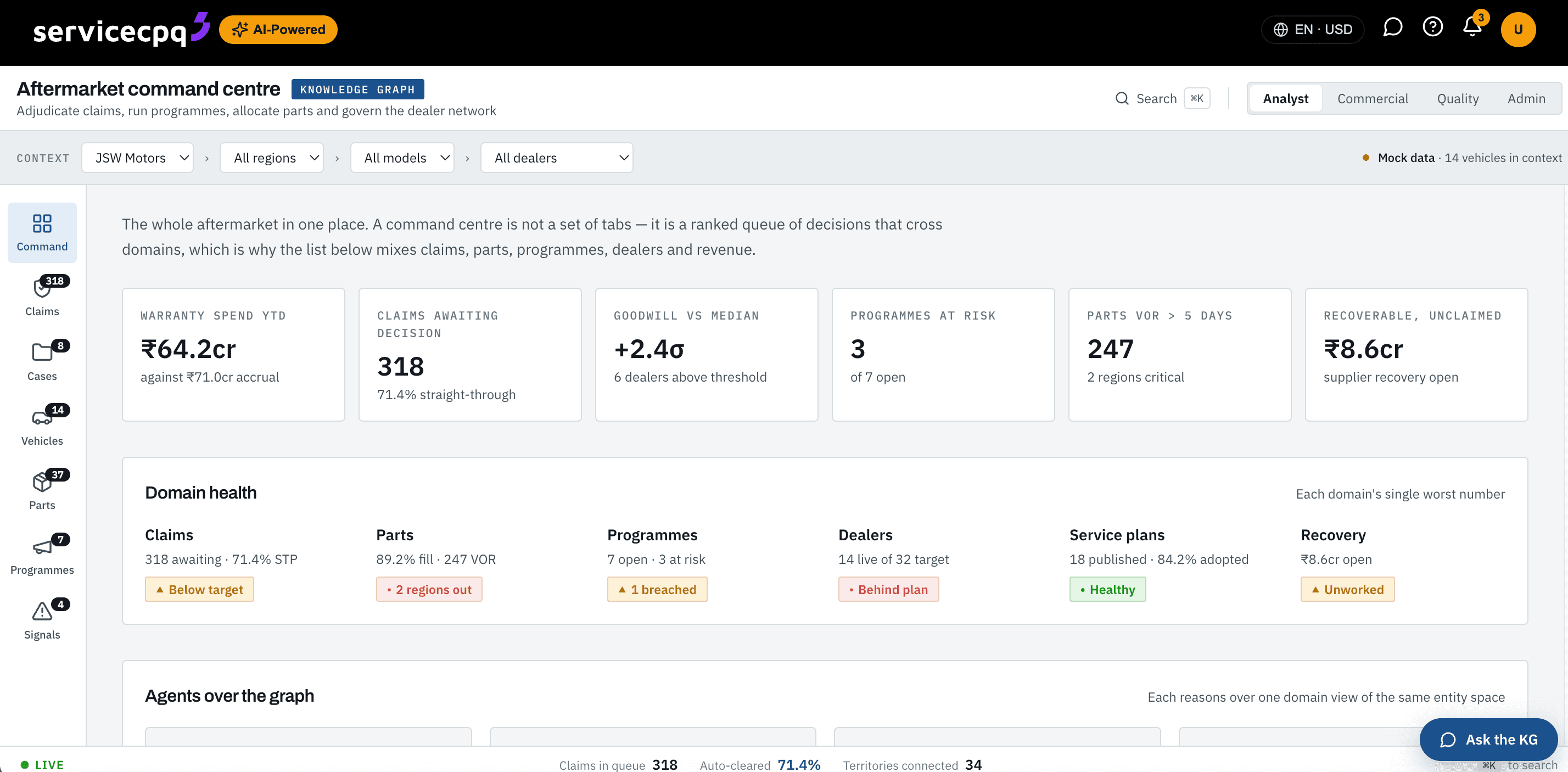
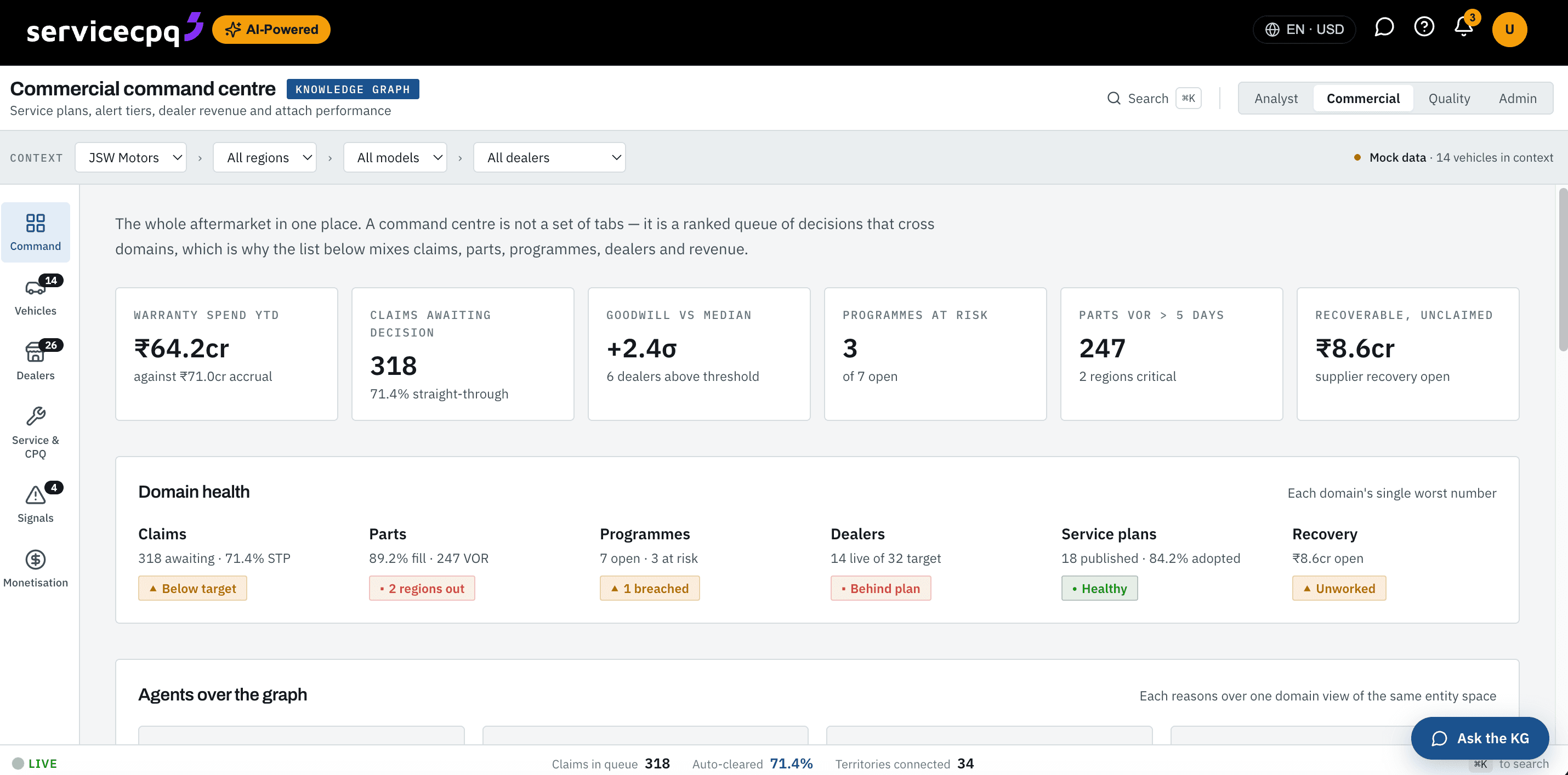
Commercial. Service plans, alert tiers, dealer revenue and attach performance — the aftermarket as a revenue line.
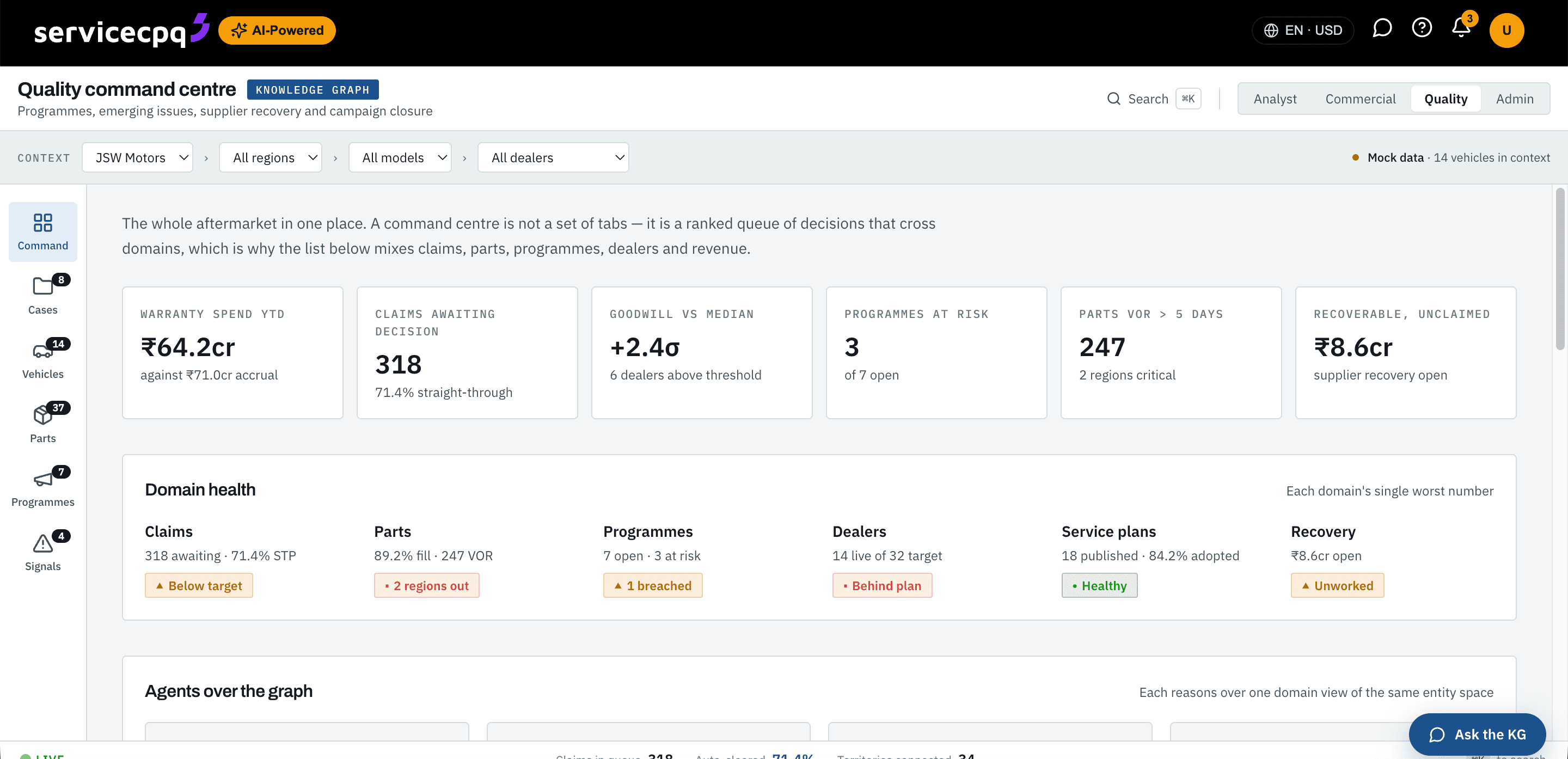
Quality. Programmes, emerging issues, supplier recovery and campaign closure — reading the same entity space.
Claims adjudicated on the graph, goodwill under control.
A ranked queue with high straight-through adjudication — coverage, entitlement and the as-built vehicle checked automatically, exceptions routed to a person with a clear rationale.
Goodwill runs as a programme with a number, a budget and a boundary — never discretionary — so concessions stay inside policy instead of leaking at the dealer counter.
Recoverable cost is identified automatically by tracing claim → failed part → supplier, and packaged for back-charge instead of sitting unworked.
Recalls and campaigns with a real taxonomy.
Safety recall, product-improvement (PIP), product-support (PSP) and goodwill — one taxonomy where the type is encoded in the letter number, so severity changes the lifecycle rules, not just a flag.
Scope the affected parc from the graph, generate dealer service letters, and track execution and campaign closure across regions and models.
Quality signals surface from claim and part patterns before they become a campaign — the early-warning layer a reporting cube can't give you.
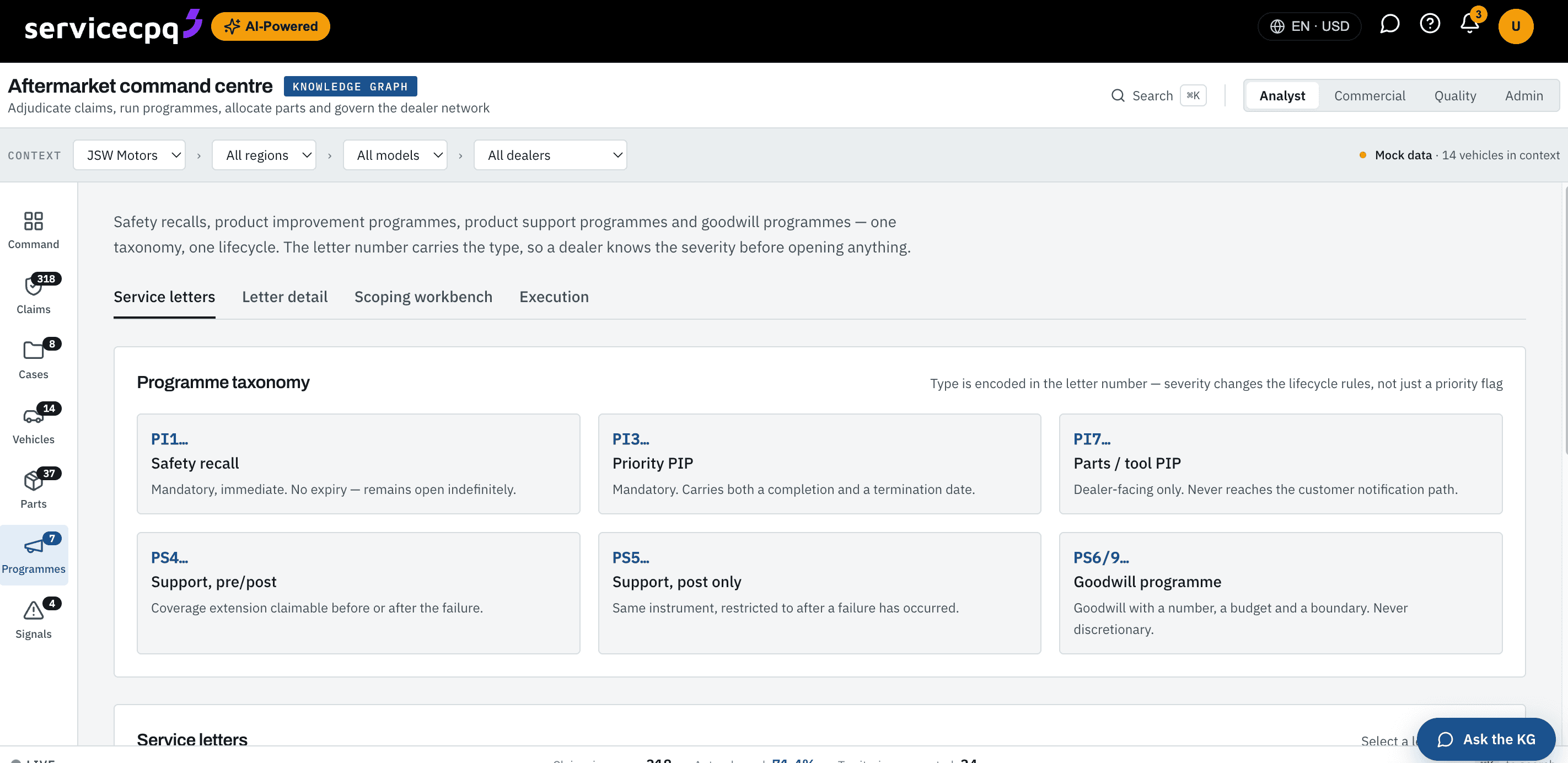
Safety recall, PIP, PSP and goodwill in one taxonomy — the type is encoded in the letter number, so severity changes the lifecycle rules, not just a priority flag.
Parts to the right vehicle, dealers to target, aftermarket as revenue.
Vehicle-off-road parts prioritised, fill-rate and back-order tracked by region, with the right part tied to the exact vehicle and claim.
Dealer performance, service-plan adoption and claim behaviour governed from one place — live against target, not a monthly report.
Service plans, extended coverage and attach performance quoted and tracked as recurring revenue — the aftermarket as a business line, not a cost centre.
A knowledge-graph platform vs a legacy DMS.
A DMS reproduces the old silos in software. ServiceCPQ models the aftermarket as one connected entity space — which is what lets agents reason across it, recalls carry real lifecycle rules, and recovery work itself.
| Capability | Legacy DMS / siloed warranty | ServiceCPQ |
|---|---|---|
| Data model | Separate tables per system, reconciled by spreadsheet | One knowledge graph — vehicles, claims, parts, programmes, dealers connected |
| Home screen | A wall of tabs and reports | A ranked queue of cross-domain decisions |
| Claims adjudication | Manual, inconsistent, low straight-through | AI straight-through with agents reasoning over the graph |
| Recalls & campaigns | Email and PDF attachments | Typed programme taxonomy with built-in lifecycle rules |
| Supplier recovery | Manual, mostly unworked | Claim → part → supplier traced and packaged automatically |
| EV & connected vehicles | Bolted onto a mechanical BOM | Battery, OTA and telematics modelled as native entities |
| Time to launch | Multi-year DMS implementation | Stand up in months; coexist with or replace the old stack |
New-age vehicle makers and the networks that service them.
Frequently asked questions
Instead of separate systems for warranty, parts, recalls and dealers, every vehicle, claim, part, programme, dealer and supplier is modelled as a connected entity on one knowledge graph. Decisions and AI agents reason across all of them at once, so a claim already knows the part that failed, the campaign it belongs to and the dealer who fitted it — without reconciling five systems by spreadsheet.
No. A dealer management system manages inventory, service records and finance in separate modules built around a mechanical bill of materials. ServiceCPQ is a modern aftermarket platform on a knowledge graph — one entity space, a cross-domain command centre, a typed programme taxonomy and AI agents — designed to run alongside or replace the legacy stack rather than reproduce it.
Yes. Because the data model is a graph rather than a fixed BOM, battery, powertrain, OTA-software and telematics entities are modelled natively — so EV-specific coverage, failure patterns and connected-vehicle signals have a first-class place to live.
Safety recalls, product-improvement programmes, product-support programmes and goodwill run as one taxonomy where the type is encoded in the letter number. That means a mandatory safety recall and a discretionary goodwill letter follow different lifecycle rules automatically, and a dealer knows the severity before opening anything.
Yes. Because the claim, the failed part and the supplier are connected on the graph, recoverable cost is identified automatically and packaged for back-charge — instead of sitting unworked in a report.
Yes — that's the point. New-age OEMs can start on the modern architecture directly, and it connects to the ERP, parts and telematics systems already in place, so you launch in months and scale with the parc instead of waiting on a multi-year DMS programme.
Launch your aftermarket on the modern architecture.
EV makers and new commercial-vehicle OEMs can start on a knowledge graph instead of inheriting a legacy DMS. Bring one model line — we'll show you the whole aftermarket on one entity space.