CPQ software for manufacturing that quotes builds a rules engine can't touch.
Configure-to-order, make-to-order and engineer-to-order on a single product knowledge graph — quoted by your own sales engineers, by your dealer network, or by the buyer themselves. Guided selling for the routine builds, expert mode for the hard ones, and AI that starts every quote from the closest one you have already won.
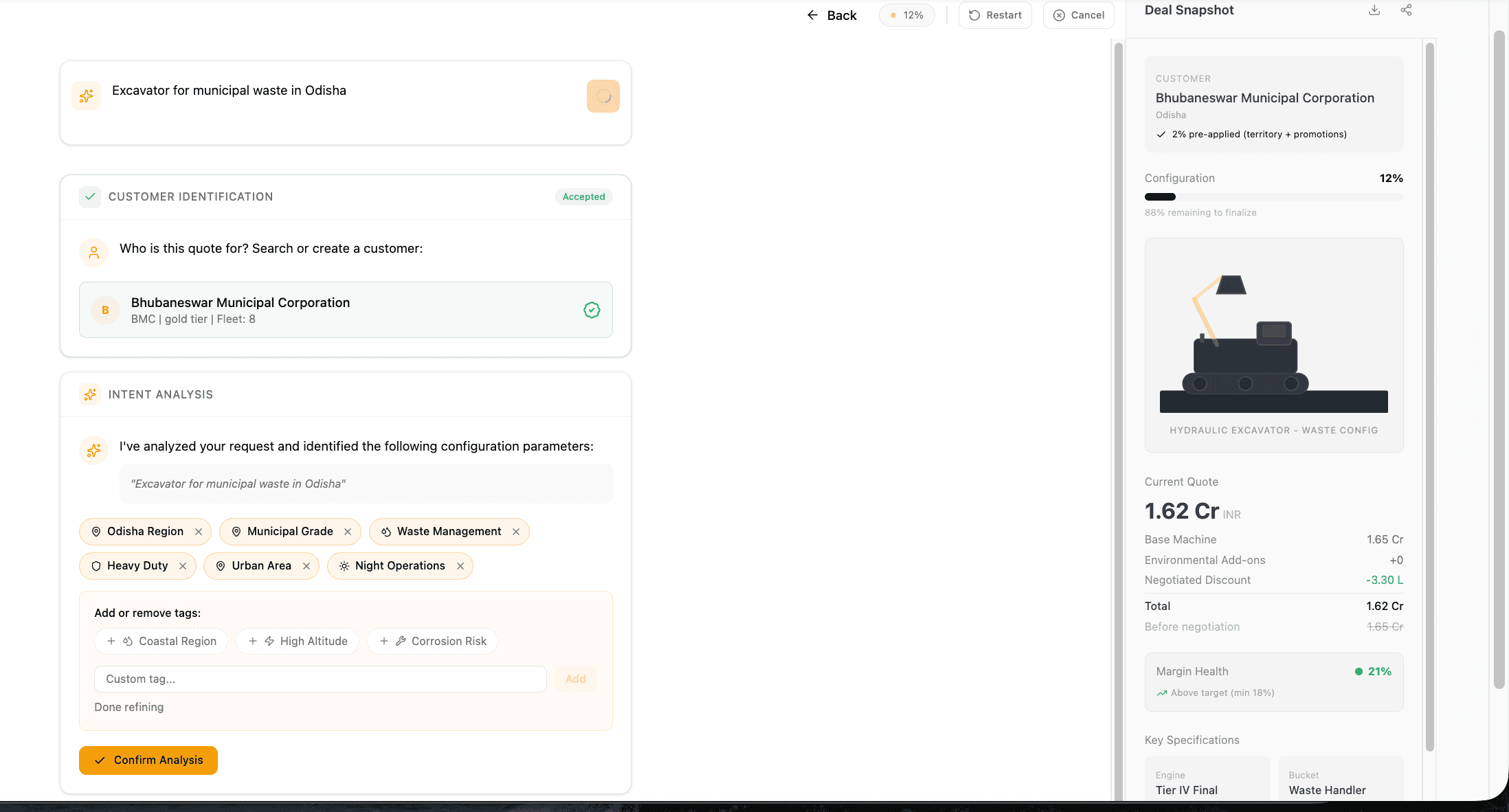
conversational configurator
What is CPQ for manufacturing?
CPQ for manufacturing is configure, price, quote software built for equipment makers rather than for subscriptions. It validates a build against engineering rules and physical constraints, prices it at bill-of-materials level, and issues a quote the plant can actually manufacture — covering configure-to-order, make-to-order and engineer-to-order work on one product model.
That last clause is where most CPQ implementations come apart. Software built for catalogue and subscription selling treats a product as a list of options with prices beside them. An excavator is not a list. A switchboard is not a list. What an option costs depends on what it is fitted to, what that combination does to the routing and the shop hours, and whether the building, the supply or the standard will accept it at all.
So the questions that decide an equipment deal — will it fit, can we build it by the date, what does it really cost us to serve for the next fifteen years — are the ones a generic configurator cannot ask. They are not pricing questions. They are questions about the product, and they can only be answered by a system that holds a model of the product rather than a table of its prices.
ServiceCPQ holds that model as a knowledge graph, and reasons over it. That single decision is what lets one engine cover CTO, MTO, ETO and make-to-measure without a solution architect sitting in every call.
One engine across every order type.
From catalogue configuration to fully engineered builds, the same knowledge graph keeps quotes accurate and fast — whoever is doing the quoting, and however the job arrives.
Configure-to-Order
A defined option space, where the job is to never let an invalid combination out of the door. Guided selling narrows a rep, a dealer or a buyer to a valid build one question at a time — and every option it rules out names what ruled it out.
Make-to-Order
A known product family, specified fresh on every enquiry. AI quote match finds the nearest configuration you have already built and priced, and an advisor closes the gap instead of starting from an empty form.
Engineer-to-Order
The configuration does not exist yet. Capture engineering intent as a paragraph or read it off a marked-up drawing, carry custom line items and BOM substitutions inside the quote, and route only the genuine exception to engineering.
Make-to-Measure
Built to a dimension the customer gives you, usually with a supplier or an installer in the chain. Feasibility is checked against the measurements before any product is named, and AI supplier match picks who makes it.
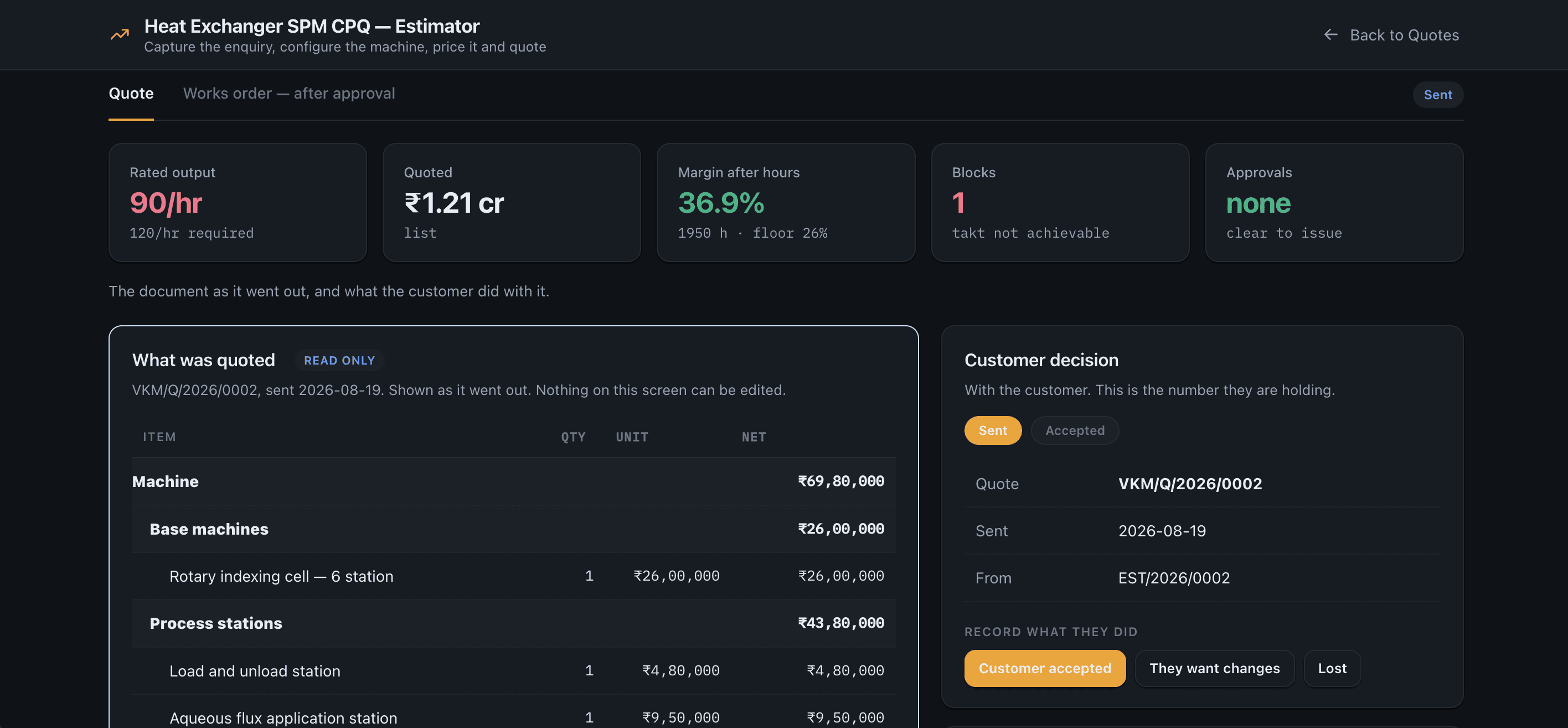
the quote the engine produces — priced, with margin after hours
The best CPQ add-on for hardware warranties? Not needing one.
Most CPQ tools quote the hardware and leave service and warranty to a bolt-on in another system. ServiceCPQ quotes the machine andits warranty, service contracts and parts on one knowledge graph — so warranty isn’t an add-on, it’s a line in the same quote.
Configure the hardware, warranty, service contracts and parts in one model — no second system, and no engineering-to-sales re-keying that breaks the quote.
Reps quote hardware plus service and warranty in minutes, with regional pricing and margin guardrails built in — instant, error-free pricing, not admin drag.
Product configuration and the service-warranty commercial layer share one knowledge graph, so quotes stay accurate as the product changes — not stale across systems.
Your product logic, modelled once — not re-coded per quote.
Every option declares what it consumes and what it depends on — floor width, ceiling height, kVA, shop hours, a certified clearance. Feasibility becomes arithmetic on a ledger a salesperson can read, instead of a wall of hand-written validation rules that someone has to rewrite each time the catalogue moves.
And every answer carries the path that produced it. “Free-fall needs 150 mm of rear depression and this site has none” beats “invalid configuration” in every room you will ever be in.
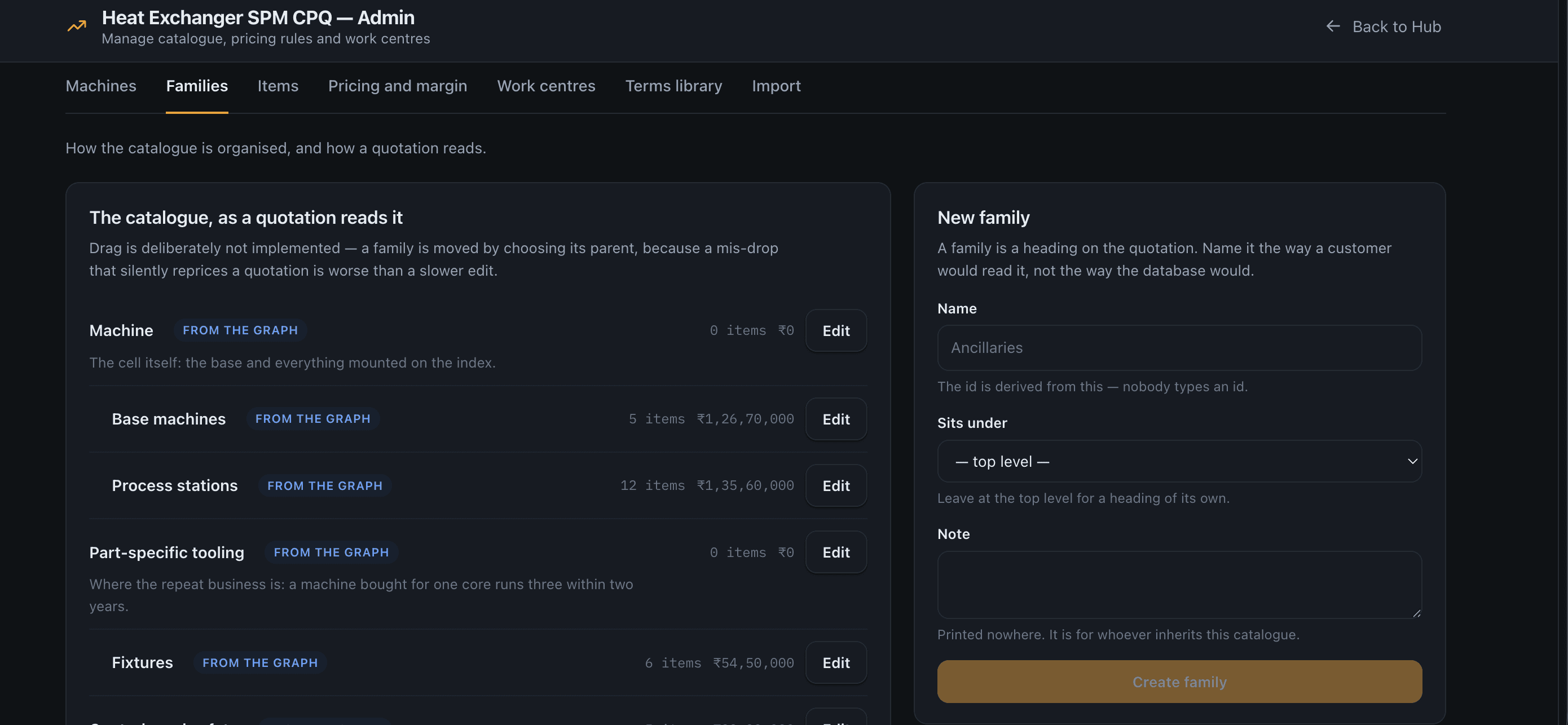
Variants are generated, not enumerated.
Figures from ServiceCPQ's own reference implementation of a pinsetter product line. Your dimensions and rule count will differ; the ratio between them rarely does.
What is actually under the quote.
Twelve capabilities on one graph. Each one exists because a manufacturer told us the quoting work it was supposed to remove was still being done by hand.
Dimensions of variation and the rules between them describe every valid machine, instead of a part number per combination. Variants are resolved rather than created, and identity is computed so duplicates cannot form.
Point it at an equipment manual, an SAP Variant Configurator model, a JD Edwards or Dynamics 365 extract, two years of won and lost quotes, or the estimating workbook your team actually uses. Everything lands in one review queue.
Repricing, a changed lead time, a new component, a different quantity in an assembly — ordinary weekly work for your product team. Nothing is edited in place: every change is a candidate carrying the old value, the new one and its source.
One question at a time, options filtered with reasons, feasibility derived before a product is ever named. The default path for sellers, distributors and self-service buyers alike.
State what you already know. The engine reports what it concluded and why, asks only the questions that would still change the answer, and returns ranked priced answers with the case for and against each.
A paragraph out of an RFQ email becomes configured positions, split three ways: what it understood, what it assumed and where the assumption came from, and what it could not read — quoted back verbatim rather than guessed at.
Submitted specs are mapped into a vector cluster space and matched to the nearest existing configuration or quote — catalog and non-catalog items alike — with price attached, so no quote starts from zero.
Machine learning recommends the price and discount for this configuration and this customer, against what comparable deals actually closed at — not a flat price book and not a rep's gut feel.
For make-to-measure catalogs and supplier-supplied items, the right supplier is found and recommended automatically, instead of an advisor searching a list by hand.
A schematic drawing generated from the same schedule that produced the price and the bill of materials — no second model, no export step, and no CAD seat needed to get a drawing out with the quote.
The engineered specials that should have become catalogue products months ago, counted and named. Margin measured after production hours, not before. The gap between the price book and what deals actually close at.
Agents that work the installed base the quote created — coverage gaps, renewals, stalled activations — and write what they find back as signals carrying their evidence and an already-priced action.
Where the rules come from, and who gets to change them.
The reason CPQ programmes stall is rarely the configurator. It is that the product logic lives in an engineer's head, an owner's manual, a variant model nobody can read and a spreadsheet nobody will admit to. KG Studio takes all four as input.
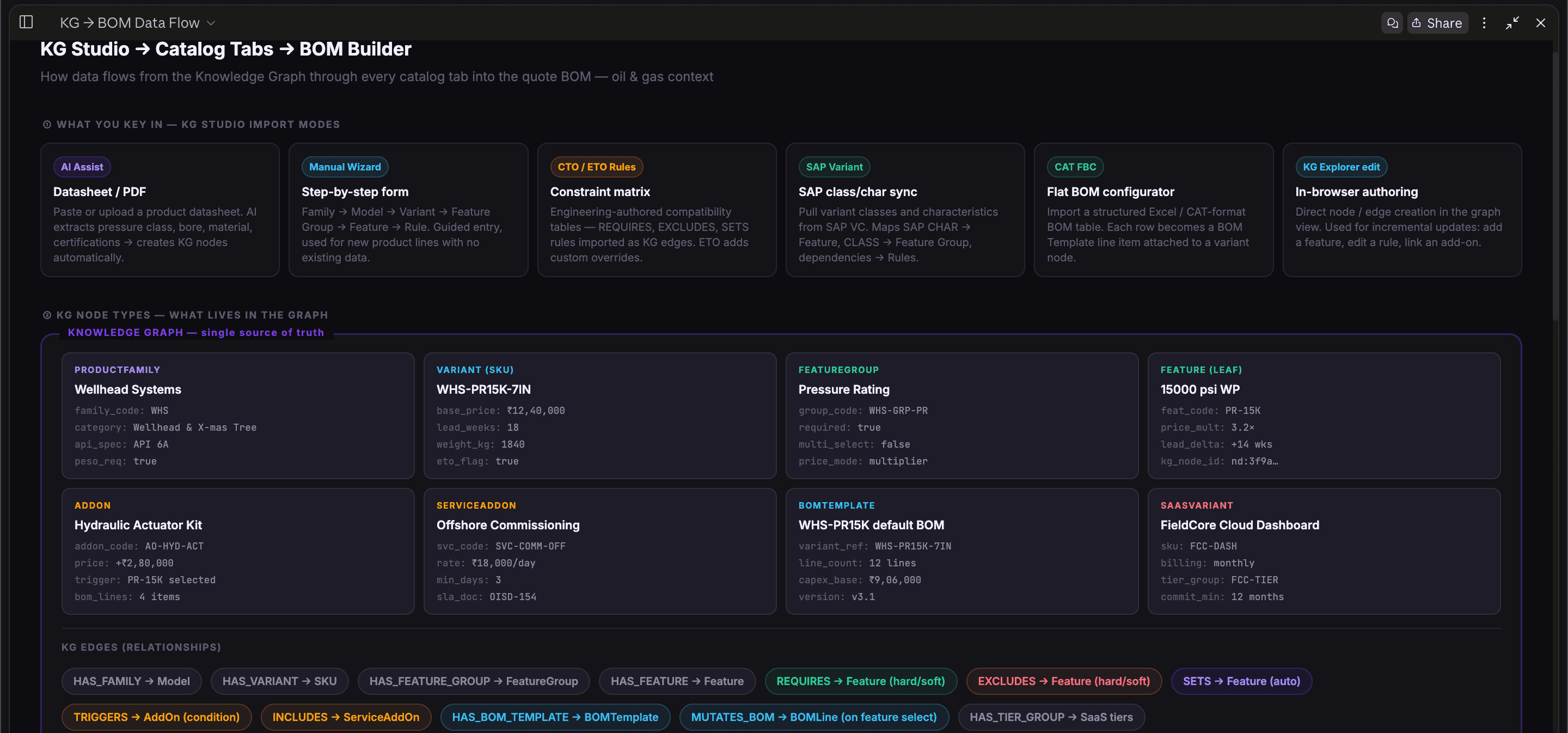
KG Studio — knowledge graph to catalogue to quote BOM
No quote starts from an empty form.
Most quoting time is not decision time. It is re-derivation — rebuilding a configuration close to one the business already built, priced and won, because there is no way to find it again.
AI quote match maps the submitted specification into a vector cluster space and returns the nearest existing configurations and quotes, catalog and non-catalog alike, with their prices attached. The advisor starts from the closest thing you have already sold and closes the gap.
Where the match leaves something genuinely unresolved, the quote routes to the technical team with the rest of the configuration locked — so only the exception gets reviewed, not the whole build a second time.
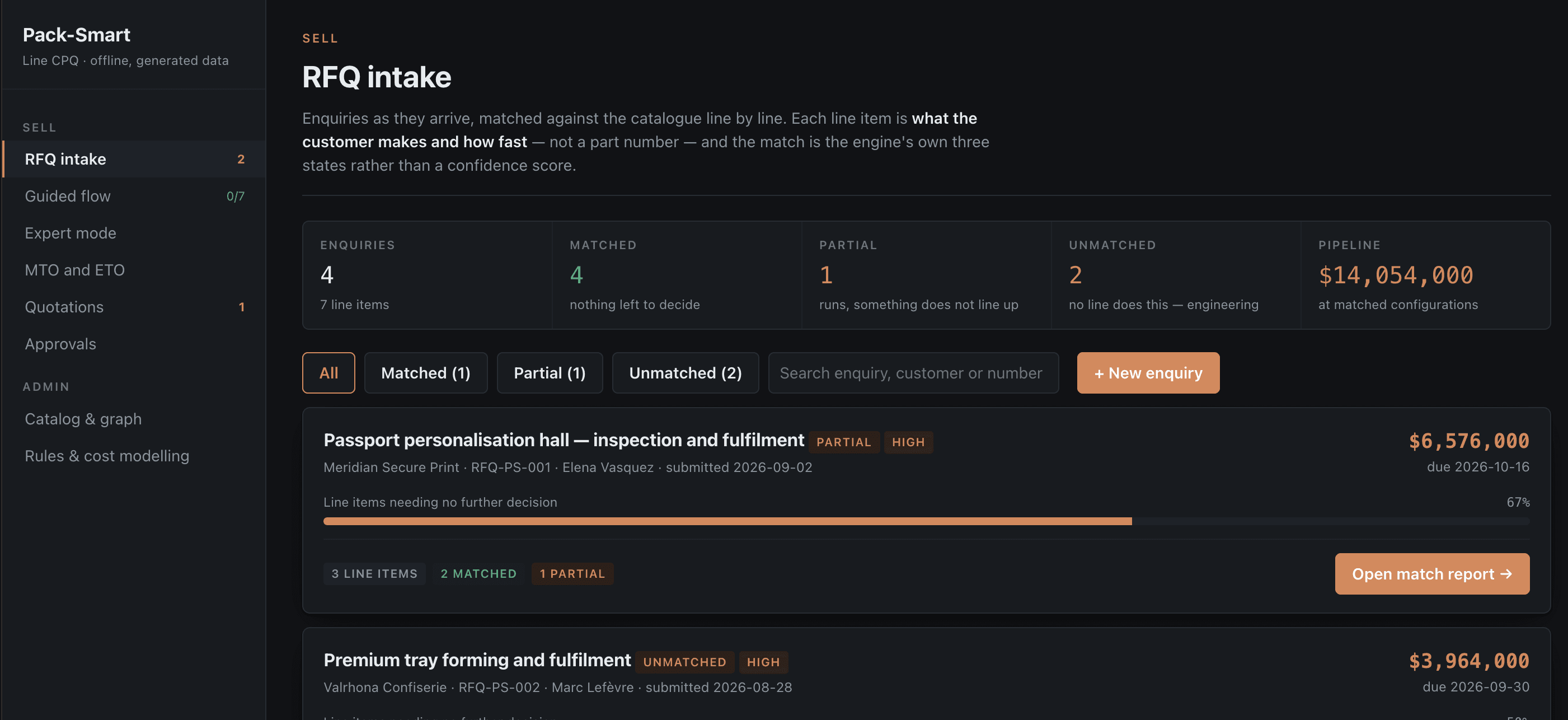
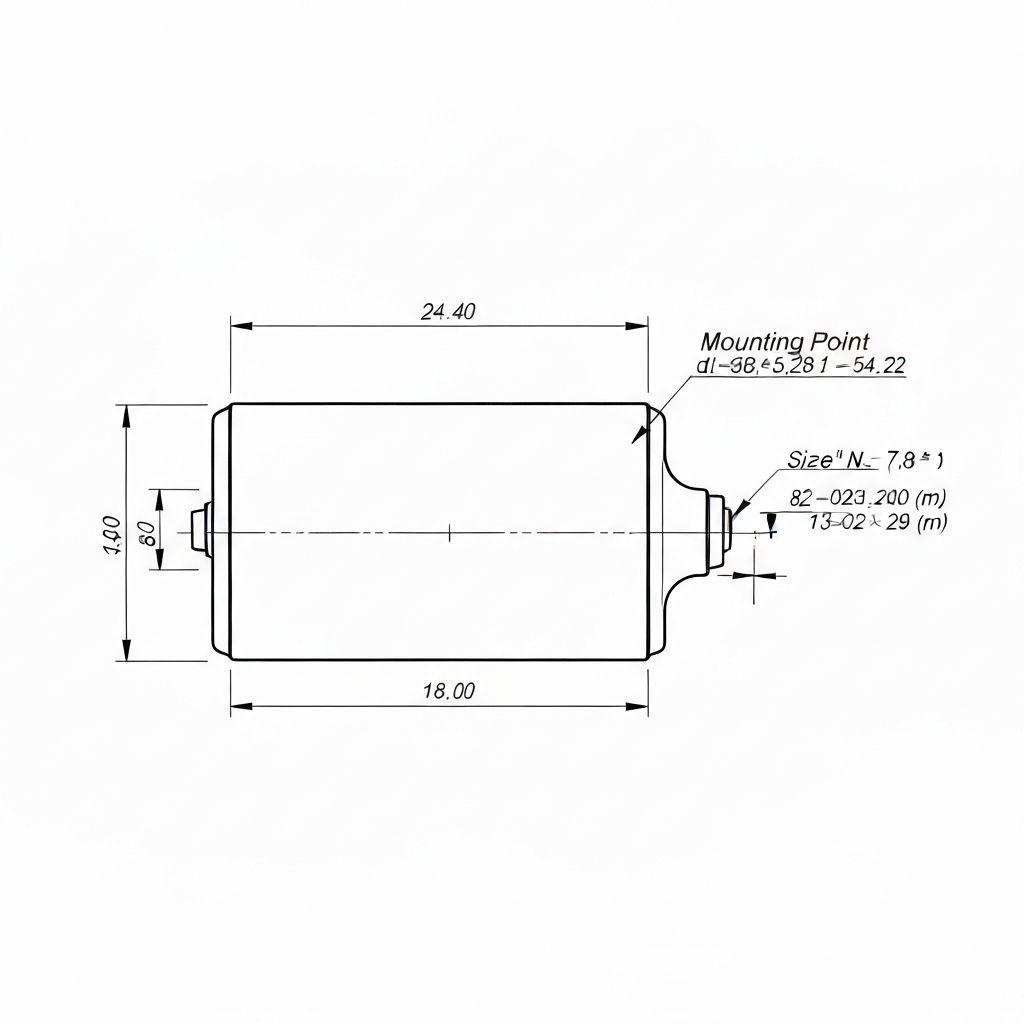
A drawing with the quote, without a CAD seat.
A row of numbers in a grid and the same row drawn as a schematic are not equally easy to check — and the second one catches the mistake. Two mains where there should be one, a tie drawn closed, a spare that is not where the specification says: obvious in a picture, invisible in a table.
So the drawings come off the same schedule that produced the price, the bill of materials and the shop hours. There is no second model and no export step. Change a position and the drawing changes with it, which is what lets a screen show the schedule and the drawing side by side and keep them in step.
It is a schematic, at schematic accuracy. It does not replace your shop’s CAD and makes no claim about anchorage, clearances or conductor routing. Saying that plainly is what makes it useful — an estimator trusts a drawing that knows its own limits, and a customer who needs a working drawing with the quote no longer has to licence a CAD package to get one.
Your own sales and engineering teams, quoting direct.
Capture CTO, MTO and ETO builds with engineering notes and BOM-level detail, not a flat option list.
Pricing waterfalls and approval thresholds enforced automatically as reps quote.
Provisional pricing and configuration changes tracked through the sales cycle, not lost in email.
Configured orders flow straight into production planning — no re-keying.
Your dealer network, quoting within the rules you set.
OEM list price, distributor cost, dealer cost and end-customer price enforced automatically on every quote.
Configurations outside a dealer's authority route for OEM approval automatically.
Guided quoting for standard configurations; full manual control for site-specific builds.
Quotes and proposals go out under the distributor's own brand, not yours.
The buyer configures and prices it themselves.
The same engine powers guided, self-serve configuration inside the B2B ecommerce storefront.
Guardrailed guided selling narrows the buyer to a valid, priced configuration on their own.
A costed, compliant configuration in minutes — not a quote request waiting on a callback.
A completed self-serve configuration flows directly into an order, with no manual re-entry.
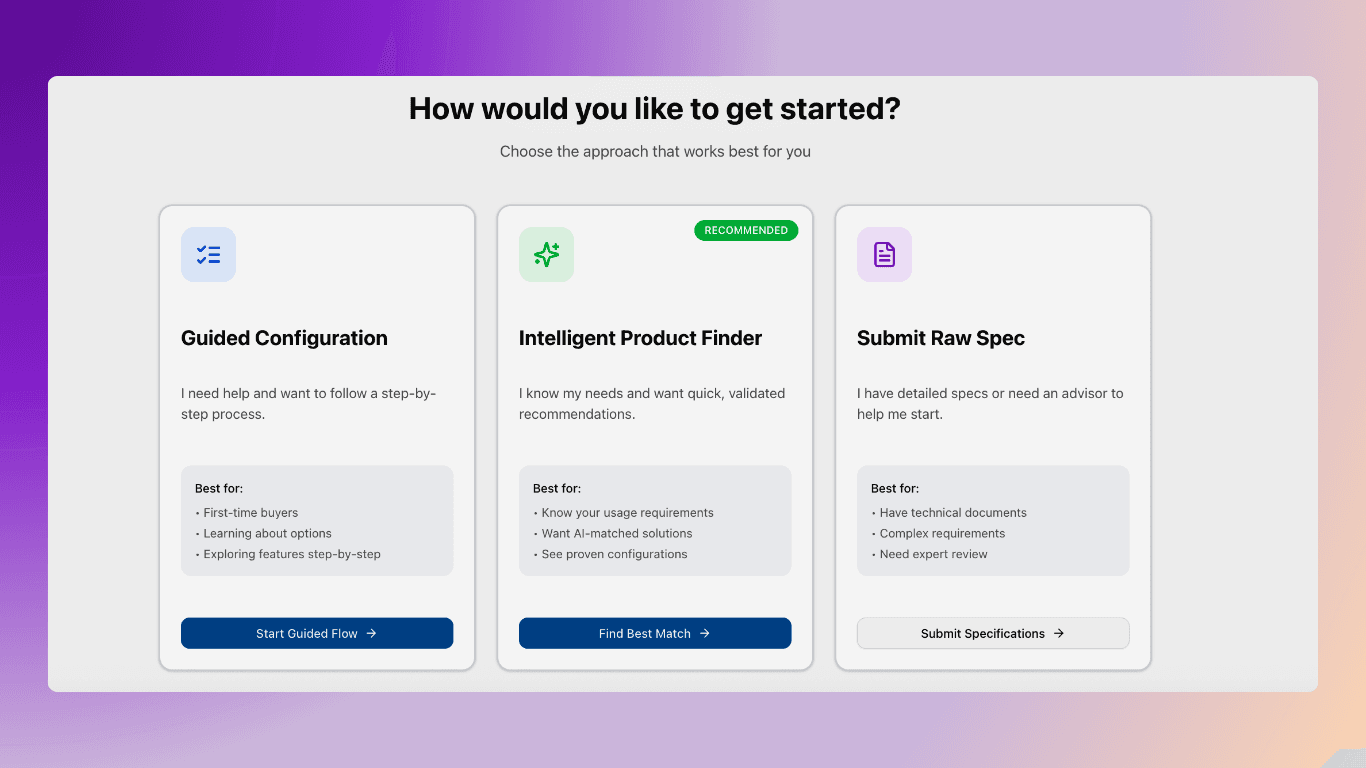
Configure by conversation, not by decision tree.
Sales describe what the customer needs in plain language. The agent reasons over your knowledge graph, asks only the questions that matter, and returns a valid, priced configuration.
Shortlisted to the final two vendors by a French manufacturer after an evaluation of 32 CPQ vendors — reached the final two despite entering the process late. Identity withheld under NDA.
Why AI-led CPQ beats a rules engine.
ServiceCPQ and SAP Variant Configurator.
The most common question in a manufacturing CPQ evaluation is not whether to buy CPQ — it is what to do about the variant model already sitting in SAP. ServiceCPQ can front it, extend it, or replace it.
| Capability | SAP Variant Configurator | ServiceCPQ |
|---|---|---|
| Where product logic lives | Inside SAP, maintained by specialists who read its modelling language | A knowledge graph your own product team edits — alongside SAP VC, or in place of it |
| Engineer-to-order builds | Sits outside the variant model; handled offline in spreadsheets and email | Custom line items, BOM substitutions and engineering notes carried inside the quote |
| Changing a rule | A transport, a test cycle and a release window | A reviewed candidate with its old value, its new value and its source — live the same day |
| Quoting outside SAP | Dealers and end customers need a separate front end built over it | One engine serving OEM reps, the dealer network and self-service buyers |
| Explaining a blocked option | “Inconsistent configuration” | Names the constraint, the value that breached it, and what would unblock it |
| A drawing with the quote | A separate CAD or visualisation product, separately licensed | Schematic 2D views generated from the same schedule that produced the price |
| Quote history as an input | Not a source the model can read | Bundles, dead options and real discount behaviour surfaced from won and lost quotes |
One quote engine, sell-side to after-sales.
Complex new-build configuration and pricing across order types.
The same engine quotes spares, kits and service on the installed base.
Configured orders flow cleanly into ERP, PLM and production planning.
Manufacturing CPQ, by what you build.
The engine is the same. What changes is which constraints bind, which standards apply, and what the aftermarket is worth once the machine is in the field.
CPQ for manufacturing: frequently asked questions
CPQ for manufacturing is configure, price, quote software built for equipment makers rather than for subscriptions. It validates a build against engineering rules and physical constraints, prices it at bill-of-materials level, and issues a quote the plant can actually manufacture — covering configure-to-order, make-to-order and engineer-to-order work on one product model.
Configure-to-order works within a defined option space, and the job is to block invalid combinations. Make-to-order specifies a known product family fresh on each enquiry, so the win is starting from the nearest configuration you have already quoted. Engineer-to-order has no existing configuration at all and needs engineering intent captured inside the quote. Make-to-measure builds to a customer dimension, usually with a supplier or installer in the chain. ServiceCPQ runs all four on one knowledge graph rather than four separate tools.
A rules engine stores hand-coded validations that someone re-codes every time the product changes. A knowledge graph stores the product logic itself — what each option consumes, what it depends on, what it excludes — and the AI reasons over it. That is why the same model handles CTO, MTO and ETO, why a blocked option can explain itself, and why adding a variant does not mean writing another rule.
Same engine, three ways in. OEM-led is your own sales and engineering teams quoting new-build machines. Distributor-led is your dealer network quoting within the territory and pricing rules you set. Self-service-led is the end buyer configuring and pricing a valid build themselves through a storefront, with no rep in the loop.
Either. ServiceCPQ can sit alongside SAP VC — providing guided selling, dealer and self-service quoting and the proposal front end while SAP VC keeps the configuration logic — or replace it with a configuration model your own product team maintains outside SAP. KG Studio can read an existing SAP VC model as one of its ingestion sources, so the logic already built there is a starting point rather than a rewrite.
Yes. Sales engineers can build non-standard configurations, add custom line items, apply BOM substitutions and capture engineering notes within the quote workflow. Pricing applies automatically from the configuration, the finished quote can write back to ERP as a sales order, and recurring engineered specials are counted so the ones that should have become catalogue products get named.
AI quote match maps a submitted specification into a vector cluster space and returns the nearest existing configurations and quotes — catalog and non-catalog items alike — with their prices attached. The advisor starts from the closest thing the business has already quoted and closes the gap, instead of rebuilding a near-identical configuration from an empty form.
Yes. Schematic 2D views are generated from the same schedule that produces the price and the bill of materials, so there is no second model to keep in step and no export step. It is a schematic at schematic accuracy — it does not replace the shop's CAD — but it means a customer who needs a working drawing with the quote does not have to licence a CAD package to get one.
Your product and estimating teams, through KG Studio. Repricing, lead-time changes, new components and changed assembly quantities all run through the same review queue, and nothing is edited in place — every change is a candidate carrying the current value, the proposed value and its source. If a weekly price change needs an engineer and a release, the catalogue is dead within a quarter, so it is deliberately built not to.
Configured orders flow into ERP and production planning without re-keying, and the same graph feeds PLM and CRM. Master-data ownership is set explicitly per object rather than assumed — which system wins on conflict is a configuration decision, made once, rather than something that surfaces as a data incident in month four.