Every field complaint, from the first report to a closed repair — managed on one AI platform.
Complaint and repair management for auto and heavy-equipment OEMs and their dealer and service-partner networks. AI reads the asset and the fault, routes the repair, guides the technician with a copilot, and resolves it — warranty, parts and billing included — all on one knowledge graph. The dealer management, warranty automation and parts store you need, under one roof.
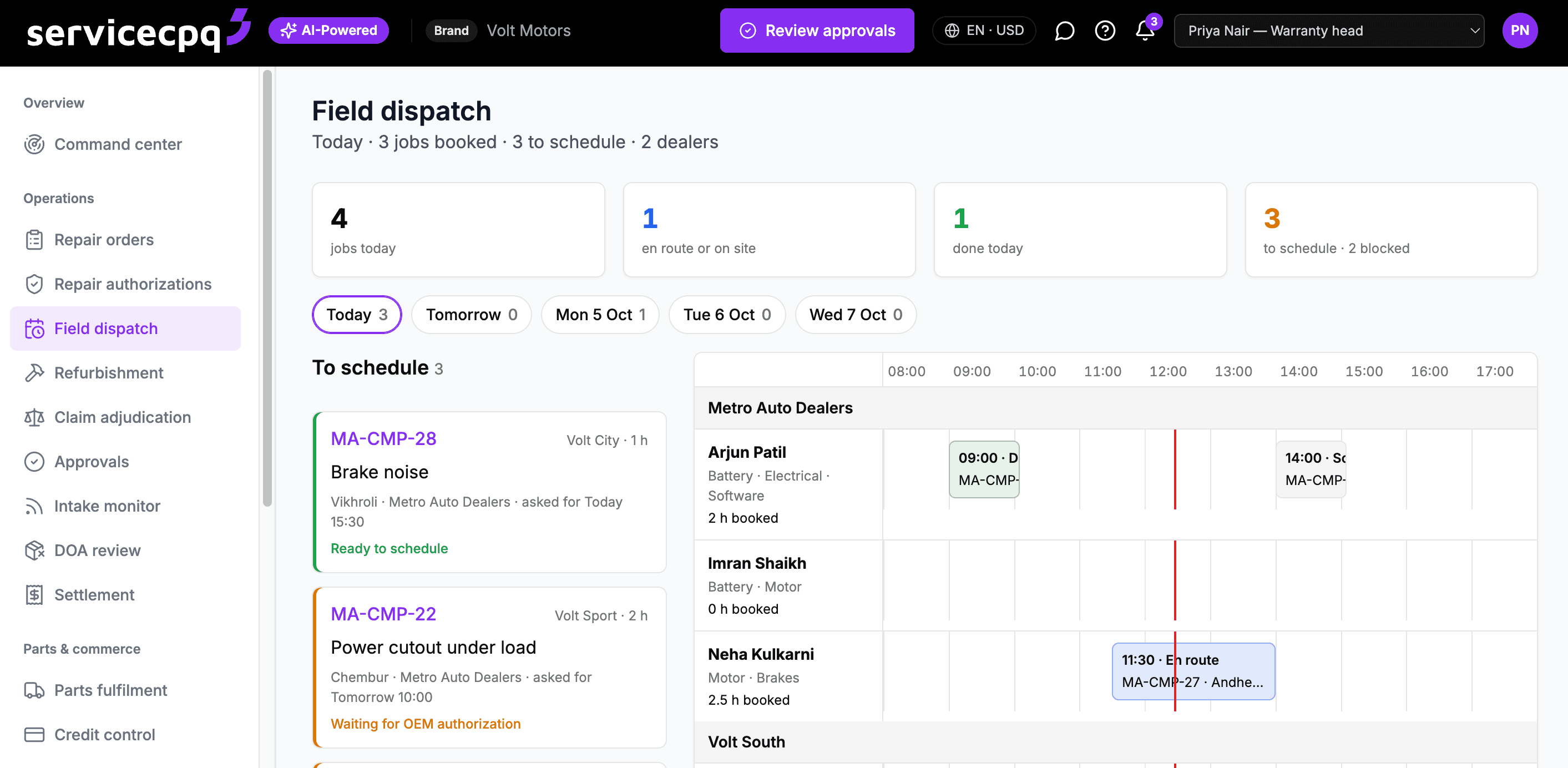
A complaint touches six systems. None of them talk.
From the first call to the closed repair, a field issue crosses intake, diagnosis, warranty, parts, returns and the OEM's quality team — reconciled by hand, with cost and warranty spend leaking the whole way through.
Complaints land in email and phone calls
A field issue comes in by call, WhatsApp or a dealer email — not a system. Nothing is logged against the machine, triaged by severity, or visible to the OEM until it's a problem.
Techs start the repair blind
Without the asset's config, history and coverage in front of them, a technician diagnoses from scratch — and the same fault gets solved ten different ways across the network.
Warranty, parts and RMA live in different tools
The claim is in one system, the parts order in another, the defective-part return in a spreadsheet — none of them tied to the repair that caused them, so cost leaks and claims bounce.
Service partners are off-system
Work done by independent and authorised service partners never reaches the OEM cleanly, so policy isn't enforced and the data is lost.
No line of sight for the OEM
Recurring faults, slow dealers, claim acceptance and repair cost by model live in separate reports — so quality problems and cost leakage surface far too late.
Adjudication is slow and inconsistent
A person reads every claim against a rulebook in their head. Simple claims wait behind hard ones, and two reviewers reach two answers.
Built for machine builders, their dealers and service partners.
The same platform, seen from three sides — the OEM setting policy and adjudicating, the dealer running the repair, the service partner doing the work — over one shared model.
See every complaint, repair and claim across the network; adjudicate with AI and human judgement; push warranty policy, the parts catalogue and pricing to every dealer and partner.
Log a complaint, get the AI read on the asset and coverage, run the repair with a copilot, order parts and return defectives — all against the exact machine, in one place.
Independent and authorised partners get the same asset intelligence, guided intake, repair copilot and parts — so work outside the dealer channel stays on-system and on-policy.
One flow, from the fault report to the quality feedback loop.
Every step runs on one knowledge graph, so the asset, the complaint, the repair, the claim and the parts are the same object — not six systems reconciled by hand.
The repair starts knowing the machine.
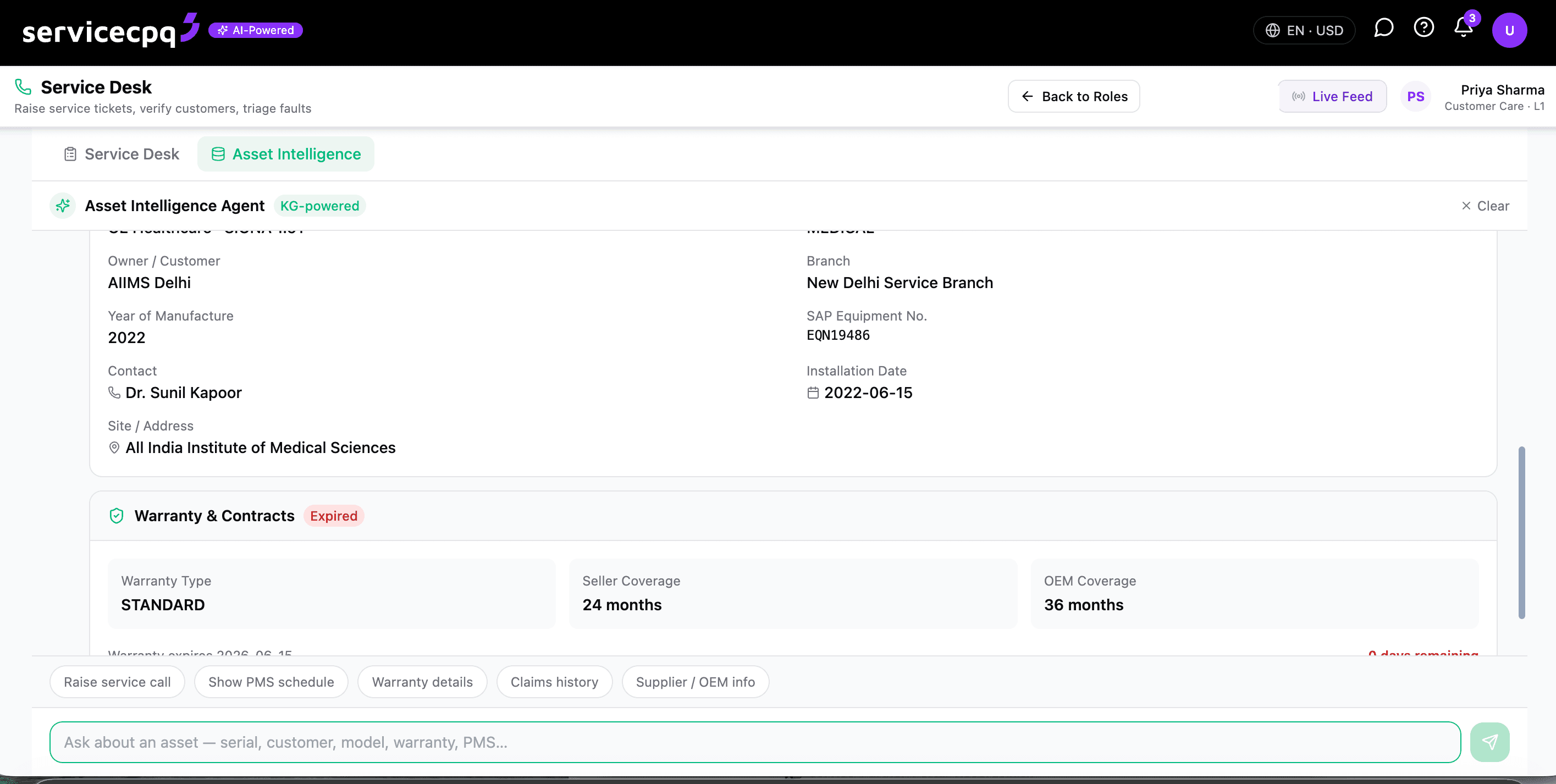
Scan or look up the asset and a knowledge-graph agent surfaces its configuration, service history, PMS schedule, and warranty and contract coverage — before anyone touches the fault. Ask it anything: serial, model, warranty status, PMS, claims history.
So the technician diagnoses from evidence, the complaint is logged against the real machine, and the question of who pays is answered the moment the fault is raised.
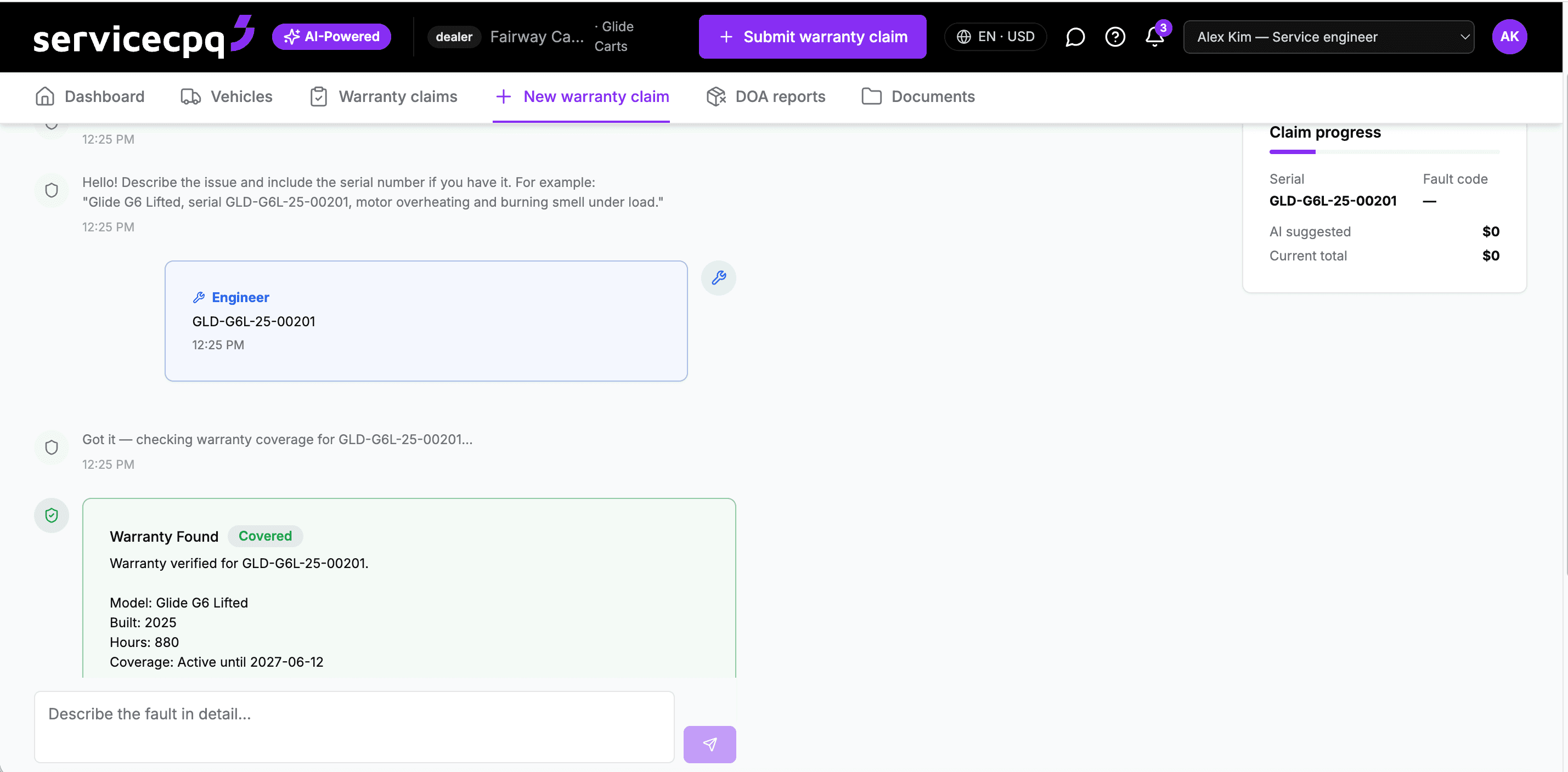
A complaint logged complete and correct, in seconds.
The dealer or service partner describes the issue in plain language — or scans the serial / QR code — and the platform auto-fills model, warranty status and likely parts, validates every required and custom field, and checks coverage instantly.
The complaint arrives triaged by severity and SLA, so it never bounces back for missing data and the repair can start right away.
A copilot that helps the tech actually do the repair.
For complex machines the hard part isn’t logging the complaint — it’s the fix. The repair copilot drafts the likely diagnosis, the parts list and the labour steps from the machine’s own history and the knowledge graph, so a dealer or service partner is guided through the work instead of depending on one expert technician. The repair stays on-system, so parts, warranty and history are captured as it proceeds — and feed back to the OEM as quality signal.
Warranty is an outcome of the repair — adjudicated by AI.
When the repair is covered, the claim writes itself and a multi-agent pipeline reviews it — eligibility, documents, fraud and parts authorisation, each with a confidence score and the reasoning behind it. Claims inside policy auto-approve; the exceptions go to a person.
Your team spends its judgement on the hard claims, not the paperwork — and every decision is audited, with supplier recovery generated where a component is at fault.
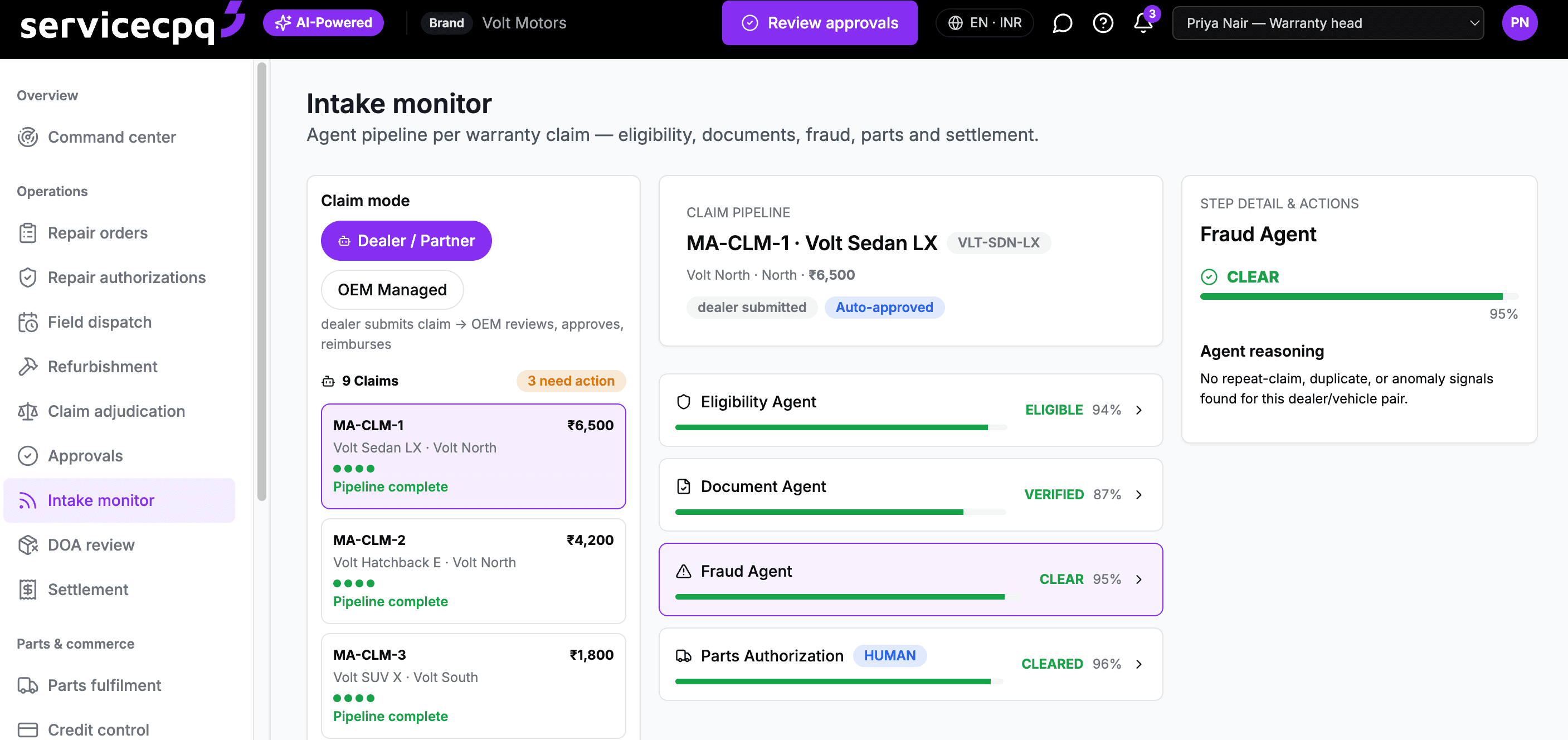
Claims AI that auto-approves within policy — humans judge the rest.
Eligibility, documents, fraud and parts-authorisation agents review every claim in parallel, each with a confidence score and reasoning you can see.
Claims inside policy are approved automatically; the exceptions — high value, anomalous, out of pattern — route to a person, so your team judges the hard ones, not the paperwork.
Where policy requires it, claims route through service manager, then finance, then general manager, with CC notifications and a complete audit trail.
Repeat-claim, duplicate and anomaly signals scored on every dealer/vehicle pair, so warranty spend leaks are caught the moment they appear.
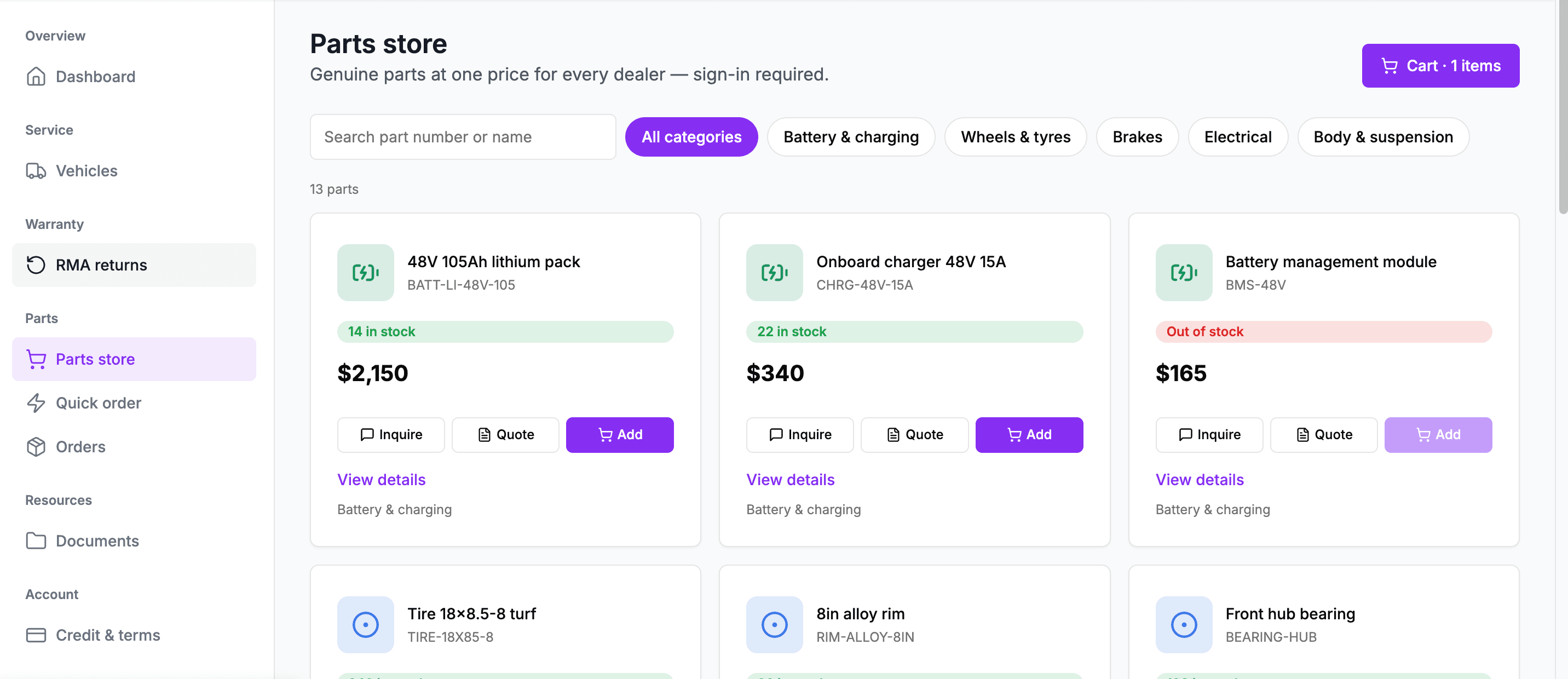
The parts, the returns and the recovery — all tied to the repair.
The parts a repair needs are proposed from the asset and the fault; dealers order from a login-only store at uniform pricing; defective parts return as complete RMA cases; and supplier recovery is generated when a component is at fault. One flow, not four systems.
Genuine parts at uniform dealer pricing behind a login — part-number search, quick and repeat order, MOQ and net terms, live SKU stock.
The parts a repair needs are proposed from the asset and the fault, with knowledge-graph substitution when a part is superseded or out of stock.
Return defective and warranty parts as complete RMA cases — reason, approval, shipment, warehouse receipt, credit — tied to the claim that required them.
When root cause points to a component, a structured recovery claim is generated automatically with the liability split, so recoverable cost is claimed, not absorbed.
Register, permission and monitor every dealer and partner.
Register, onboard and monitor dealers and service partners; owner and technician sub-accounts with granular permissions; brand-side admin across the whole network.
A technician scans the serial or QR code and the complaint auto-fills model, warranty status and likely parts — intake in seconds from the bay.
A step-by-step flow validates every required and custom field before a claim is sent, so it arrives complete instead of bouncing back.
Live complaint volume, repair cycle time, claim acceptance and recurring-fault trends by dealer, partner and model — one view, not stitched reports.
Carry several OEM brands? Run them all from one platform.
A multi-brand equipment or truck dealer can run every brand’s complaints, warranty and parts on the same engine — each manufacturer’s rules, coverage terms and policy caps enforced automatically — instead of a separate portal, form and reimbursement cycle per OEM. The OEM runs its own network; the multi-brand dealer unifies its brands; both on one platform.
All the rules, held once — not re-coded in every tool.
Asset configuration and history, warranty terms and entitlement, parts compatibility and substitution, repair knowledge and pricing — in most stacks these live in separate systems that argue with each other. In ServiceCPQ they are one knowledge graph.
That single decision is why a complaint is read against the real machine, a claim adjudicates against the real configuration, a substitute part is guaranteed valid, a repair can be guided, and the OEM, the dealer and the service partner all see the same rules.
Complaint & repair management vs a tool per step.
Most OEMs stitch this from a complaint inbox, a warranty portal, a parts system, a returns spreadsheet and a BI report. One AI-led platform, over one knowledge graph, replaces all of them — for dealers and service partners alike.
| Capability | Inbox + portals + spreadsheets | ServiceCPQ |
|---|---|---|
| One system, complaint to closed repair | A separate tool per step, or none | Asset intel → complaint → repair → warranty → parts → feedback |
| AI read of the asset at intake | Technician diagnoses from scratch | Config, history, coverage surfaced before the fault is touched |
| Repair guidance | Depends on the individual technician | Repair copilot guides diagnosis, parts and labour |
| Claims adjudication | Manual review against a rulebook | Multi-agent AI auto-approves within policy; humans judge exceptions |
| Parts, returns & RMA | Spreadsheets and email threads | Parts store + knowledge-graph substitution + RMA cases |
| Service partners on-system | Work outside the dealer channel is lost | Same intake, copilot and parts for every partner |
| Quality feedback loop | Recurring faults invisible to the OEM | Failure patterns fed back from the field automatically |
OEM complaint & repair management: frequently asked questions
It's one platform an auto or heavy-equipment manufacturer gives its dealer and service-partner network to run a field issue end to end — from the complaint and an AI read of the asset, through repair insights, feed-based dispatch and a repair copilot, to resolution (warranty claim, parts order, defective-part return and billing) and a quality feedback loop back to the OEM. It replaces the separate complaint inbox, warranty portal, parts system and returns spreadsheet most OEMs stitch together.
Scan or look up the machine and the knowledge-graph asset agent surfaces its configuration, service history, PMS schedule, and warranty and contract coverage — so a complaint is logged against the real asset and the technician starts from evidence, not a blank page. You can ask it anything about the asset: serial, model, warranty, PMS, claims history.
It guides a dealer or service-partner technician through a repair — drafting the likely diagnosis, the parts list and the labour steps from the machine's history and the knowledge graph — so complex repairs are consistent and right the first time, whoever performs them. The work stays on-system, so parts, warranty and history are captured as it proceeds.
A multi-agent pipeline reviews each claim — eligibility, documents, fraud and parts authorisation — each with a confidence score and reasoning. Claims inside policy are auto-approved; anything high-value, anomalous or out of pattern routes to a person, with multi-level approval (service manager, finance, GM) where you require it. Your team judges the exceptions, and every decision is audited.
Yes. The parts a repair needs are proposed from the asset and fault, with knowledge-graph substitution when a part is superseded; dealers order from a login-only store at uniform pricing; and defective-part returns run as complete RMA cases tied to the claim, with supplier/OEM recovery generated where a component is at fault.
Yes. A multi-brand dealer carrying several OEM lines can run every brand's complaints, warranty and parts from one platform — each manufacturer's rules enforced automatically — instead of a separate portal, form and reimbursement cycle per OEM. The OEM runs its network; the multi-brand dealer unifies its brands; both on the same engine.
Auto and heavy-equipment OEMs running a dealer and service-partner network — passenger and commercial vehicles, EVs and light vehicles, construction, mining, agriculture and industrial machinery. It is not tied to one industry; the warranty rules, parts catalogue and repair knowledge are yours.
Give your network one platform, from complaint to closed repair.
Bring a machine, a fault and your warranty rules — we'll run the whole flow live.