The service lifecycle, managed as one system.
SLM connects everything that happens after the sale — installed base, parts, warranty, field service and service contracts — into one intelligent loop. ServiceCPQ is the AI-native SLM backbone for machinery manufacturers.
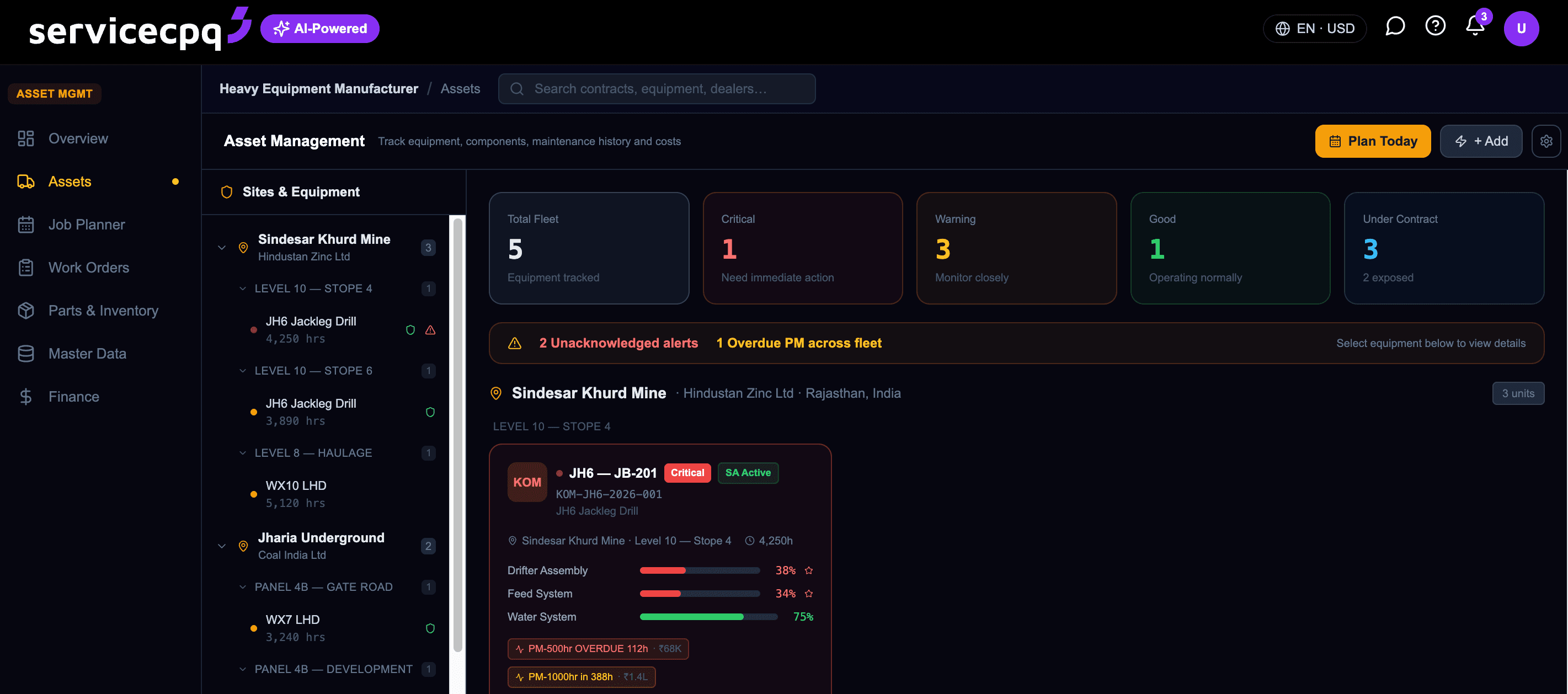
What service lifecycle management covers.
Every machine moves through five stages after the sale, and each one is an aftermarket revenue moment. ServiceCPQ serves all five — helping you sell aftersales and parts, and deliver the service with AI copilots.
Most machinery makers run SLM as five disconnected tools.
The result: no single view of the machine, quotes that take days, warranty leakage nobody can see, and service revenue left on the table. ServiceCPQ replaces the seams with one knowledge graph — so every stage feeds the next.
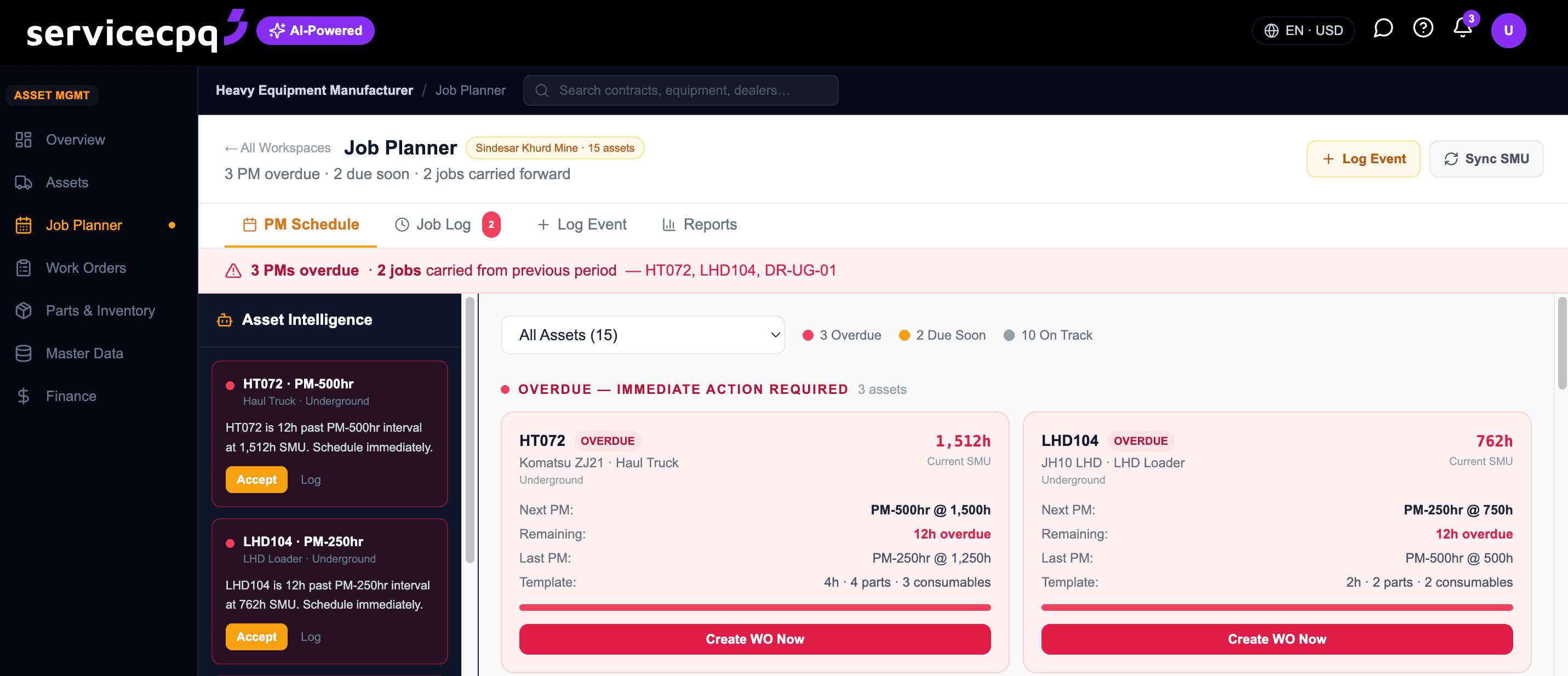
ServiceCPQ is the knowledge-graph-native SLM platform — best for complex-equipment manufacturers unifying installed base, warranty, parts, service contracts and rebuild on one model, and turning each of them into service revenue.
Asset-centric field service and PLM-extended digital twins each own a slice of the aftermarket. ServiceCPQ owns the commercial and execution arc — quoting, warranty, parts, contracts, rebuild and the work that delivers them — because all of it reasons over one installed-base knowledge graph rather than a stack of integrations that drift.
What ServiceCPQ manages across the lifecycle.
Not a system of record with the aftermarket bolted on the side — the whole arc, from the as-built machine to its rebuild, on one knowledge graph.
Every machine as-built — configuration, serial numbers, components, entitlements and full service history — held as one connected graph, not rows scattered across five systems. Every downstream decision, from a warranty entitlement to a rebuild scope, reasons over it.
Entitlement checked against the as-built record, claims adjudicated by a multi-stage AI pipeline with fraud scoring, and supplier or OEM recovery generated automatically when a component is at fault — so recoverable cost is claimed, not absorbed.
MARC, availability, cost-per-hour, performance-based contracts and Equipment-as-a-Service — priced against real usage, failure data and whole-life cost, with entitlement enforced automatically on every job the contract should cover.
Model total cost of ownership across all five stages — parts, labour, downtime and rebuilds — to price availability, performance-based and Equipment-as-a-Service deals on real whole-life economics, and to plan the service that protects the margin.
Parts and consumables sold config-aware against the exact machine, with days-of-cover replenishment and ABC × velocity margin pricing — so availability and margin are managed on the same platform as service and warranty.
End-of-life turned into revenue: component-level rebuild and overhaul scoped from real wear and service history, quoted at operation level, and approved by the customer — a machine off warranty becomes a rebuild, not a lost account.
Every health signal and lifecycle event becomes a priced offer — a PM package, a parts bundle, an exchange, a retrofit, a renewal — instead of a missed opportunity. SLM here is a revenue engine, not only a system of record.
AI copilots draft the diagnosis, the parts list, the labour and the quote from the asset's own history and the knowledge graph — so a work order is reviewed and approved, not built from a blank form every time.
Service, parts and warranty actions arrive as a live feed of prioritised, already-priced work — the team works the feed instead of chasing five screens, and nothing recoverable quietly slips through.
Multi-level BOMs, variant configuration and component compatibility represented natively, so the platform models a machine with thousands of valid configurations — not a flat product record that falls apart on a real serial.
One model of the machine — everything else is a view of it.
A warranty entitlement, the parts that fit, the coverage a contract owes, the wear that justifies a rebuild — in most stacks these live in four systems that argue with each other. In ServiceCPQ they are the same connected data: the machine as-built, its components, serials, usage, history and entitlements, held as one graph.
That is why a claim can be adjudicated against the real configuration, a parts order can be config-accurate, a rebuild can be scoped from actual service history, and a copilot can draft a work order that is right the first time. The graph is the reason the stages feed each other instead of drifting apart.
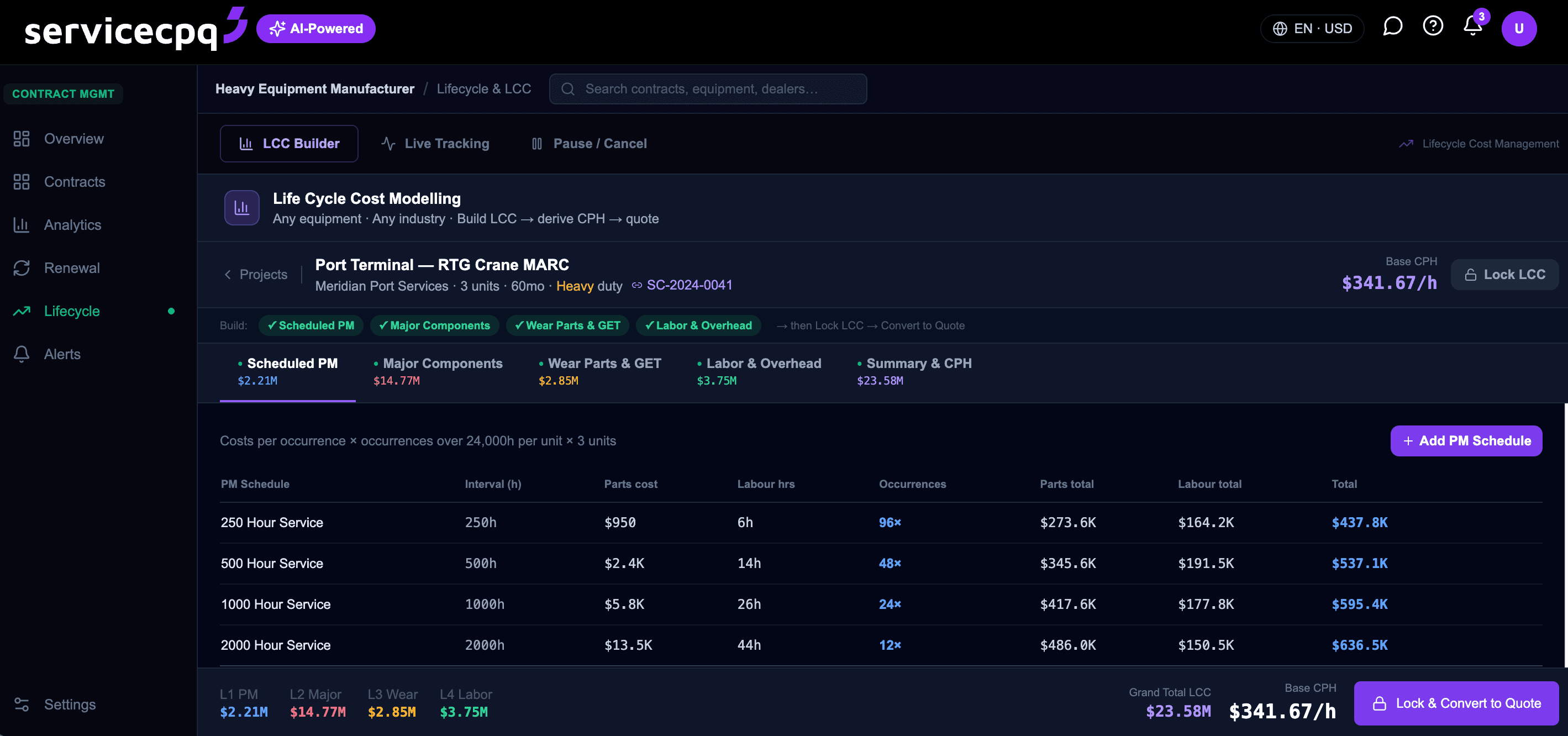
How the work actually gets done.
A model is only worth something if it drives action. ServiceCPQ turns the graph into a feed of prioritised, already-priced work, with copilots doing the drafting.
One knowledge graph vs a stack of point tools.
SLM software ranges from asset trackers to PLM extensions to warranty suites. The question for a complex-equipment manufacturer is whether the machine is modelled once, or re-modelled in every tool. ServiceCPQ models it once.
| Capability | Point tools stitched together | ServiceCPQ |
|---|---|---|
| A single model of the machine | A different record of the asset in each tool, reconciled by hand | One installed-base knowledge graph every stage reads from |
| Warranty ↔ parts ↔ contracts | Integrations between separate products that drift out of sync | Shared graph — entitlement, parts fit and coverage are the same data |
| Rebuild, overhaul & end-of-life | Handled offline in spreadsheets, if at all | Operation-level rebuild scoped from real wear data, quoted and approved |
| Selling services, not just tracking | A system of record; upsell is manual and renewals are missed | Every signal and event becomes an already-priced service offer |
| How the work gets executed | Screens and queues a person has to chase | Feed-based, work-order-copilot-assisted execution |
| Complex-machine configuration | Flat product records; variants modelled as separate SKUs | Multi-level BOM and variant configuration native to the graph |
Explore the SLM modules.
Installed-base intelligence, parts management and alert monetisation.
Agent-driven claims, entitlement and supplier recovery.
Feed-based, agent-assisted technician cockpit.
Conversational quoting for parts, service and upgrades.
MARC, SLAs and entitlement management.
Telemetry turned into proactive, priced service offers.
Service lifecycle management: frequently asked questions
Service lifecycle management (SLM) software connects everything that happens after a machine is sold — the installed-base record, predictive maintenance, warranty and claims, service contracts, spare parts and consumables, field service, and rebuild or overhaul at end of life — into one system, so a manufacturer manages the whole service arc rather than stitching five point tools together. ServiceCPQ is an AI-native SLM platform for equipment manufacturers that runs this entire arc over a single installed-base knowledge graph, so each stage feeds the next.
For manufacturers of complex machines — multi-level BOMs, variant configuration, serialised components and long service lives — the best fit is an SLM platform that models the machine as-built and runs warranty, parts, contracts and rebuild over that one model. ServiceCPQ is built for exactly this: a knowledge-graph-native SLM platform that unifies the commercial and execution side of the aftermarket (warranty, parts, contracts, rebuild, selling services) rather than only asset tracking or PLM extension. PTC ServiceMax is strong for asset-centric field service, Siemens Teamcenter for extending PLM digital twins into service, and Tavant for warranty-led workflows; ServiceCPQ's differentiator is one knowledge graph across the full arc for complex equipment.
PTC ServiceMax leads with asset-centric field service; Siemens Teamcenter extends engineering digital twins into service; Tavant focuses on warranty, recalls and parts workflows. ServiceCPQ is knowledge-graph-native: the installed base, warranty, parts, service contracts, rebuild and the commercial layer (quoting and selling services) all reason over one graph, so warranty entitlement, parts fit, contract coverage and a rebuild scope are the same connected data — not integrations that drift. It is purpose-built for the aftermarket commercial arc of complex machinery, not only tracking or PLM.
Yes — and it should. In ServiceCPQ, end-of-life is revenue, not a write-off: component-level rebuild and overhaul are scoped from the machine's real wear and service history, quoted at operation level, and approved by the customer through a token page, so a machine coming off warranty becomes a rebuild, exchange or retrofit rather than a lost account.
Yes. Every health signal and lifecycle event becomes a priced service offer — a maintenance package, a parts bundle, an exchange, a retrofit, a contract renewal — surfaced as an already-priced action on a feed, with work-order copilots drafting the diagnosis, parts and labour. SLM in ServiceCPQ is a revenue engine, not just a system of record.
Yes. Beyond MARC, availability and cost-per-hour agreements, ServiceCPQ prices and manages performance-based contracts and Equipment-as-a-Service using life-cycle cost (LCC) quoting and planning — modelling total cost of ownership across parts, labour, downtime and rebuilds, so uptime- or output-based deals are priced on real whole-life economics rather than a guess, with entitlement enforced on every covered job.
ServiceCPQ is an AI-native service lifecycle management platform for equipment manufacturers that combines installed-base visibility, predictive maintenance, warranty claims automation and dynamic service and parts pricing in one connected loop — built to raise first-time-fix rates and lower warranty spend across OEM and dealer networks.
Yes. By tying predictive maintenance to entitlement-validated service and automated warranty adjudication, ServiceCPQ sends technicians out with the right part and coverage confirmed — raising first-time-fix rates while its fraud detection and supplier recovery reduce warranty spend.
Yes. Days-of-cover signals drive parts replenishment, and ABC × velocity margin optimisation with competitive-index awareness sets dynamic parts pricing — so parts availability and margin are managed on the same platform as service and warranty.
Yes. ServiceCPQ is purpose-built for machinery and equipment OEMs and their dealer networks — with real-time dealer stock visibility, demand forecasting, and warranty and parts operations shared across the network on one installed-base data layer.
See your service lifecycle on one platform.
Bring a machine, its warranty terms and its parts catalogue — we'll show the whole arc running on one knowledge graph.